PEEK & Engineering Plastic Parts
Custom PEEK Machined Parts
Custom PEEK machined parts for prototypes and low-volume production. CNC machining for precision PEEK components with support for drawings, tolerances, material requirements and inspection needs.
Custom PEEK Machined Parts
YSBK Parts provides custom PEEK CNC machining for prototypes, replacement components and low-volume production.
We machine PEEK parts from customer drawings and 3D models, with support for material selection, manufacturability review, dimensional requirements and inspection needs.
PEEK is often selected for demanding components where engineers require a combination of mechanical strength, dimensional stability, chemical resistance, electrical performance or elevated-temperature capability. However, machining PEEK requires different considerations from machining metals, particularly when the part includes thin walls, tight tolerances or complex geometry.
PEEK CNC Machining Capabilities
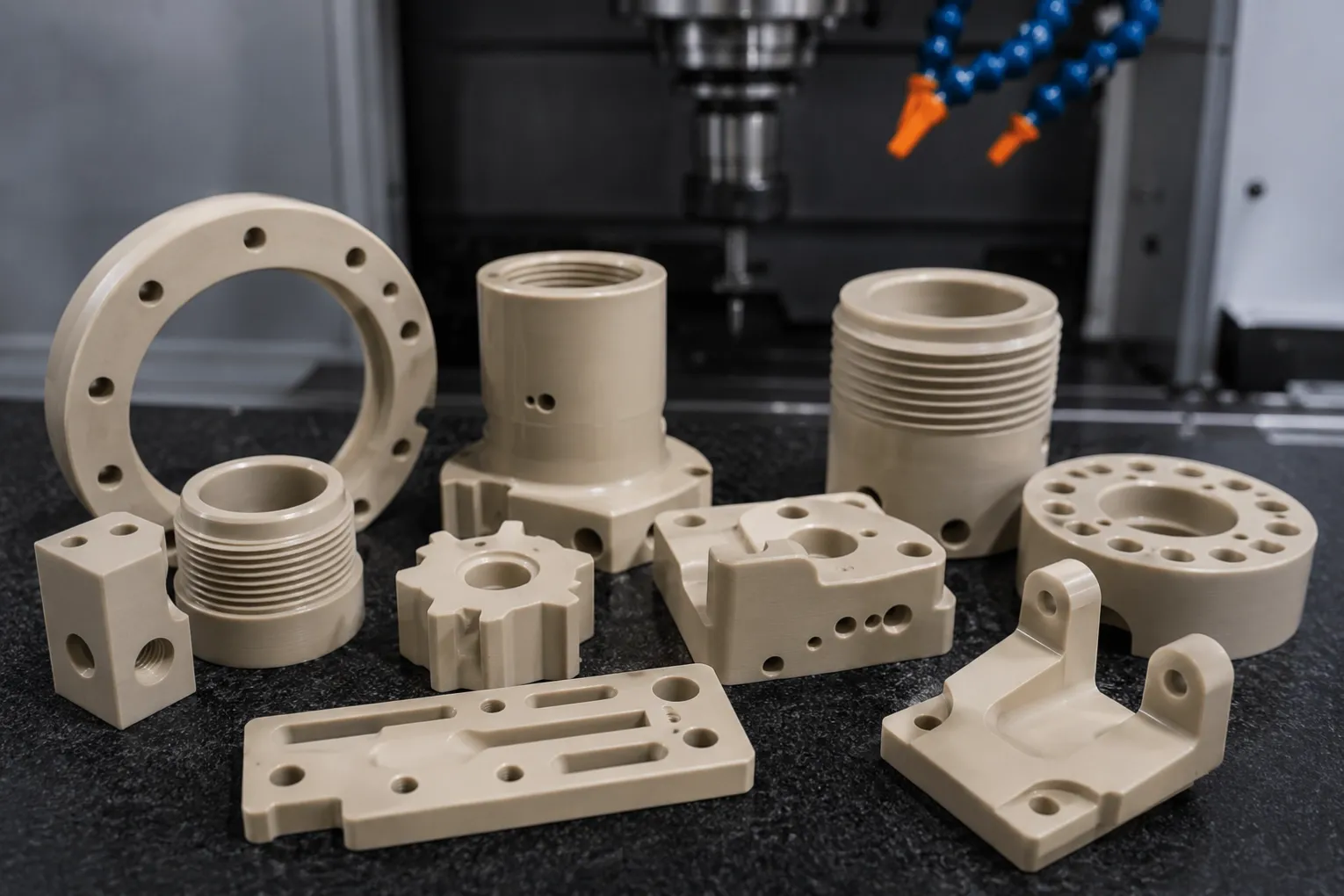
We support custom PEEK components including:
- CNC milled PEEK parts
- CNC turned PEEK parts
- Bushings and sleeves
- Insulating components
- Spacers and mounting parts
- PEEK housings and brackets
- Threaded PEEK components
- Prototype and replacement parts
- Low-volume production parts
- Complex parts manufactured from customer drawings
Send us your STEP, STP, PDF, DWG or DXF files for review.
PEEK Materials We Can Review for Your Project
Different PEEK grades behave differently during machining and in the final application.
Depending on your drawing and application requirements, projects may involve:
Unfilled / Natural PEEK
Suitable for many general precision components requiring the inherent properties of PEEK.
Glass-Filled PEEK
Often considered where increased stiffness or dimensional requirements are important.
Carbon-Filled PEEK
Used in applications where additional stiffness, strength or wear-related performance may be required.
If a specific PEEK grade or manufacturer is required, include it on your drawing or RFQ.
Material properties vary by grade and reinforcement, so material selection should be based on the actual operating conditions and design requirements rather than simply specifying “PEEK.” Reinforced grades can behave differently from unfilled PEEK during machining.
What Makes PEEK Machining Different?
PEEK can be CNC machined into highly detailed components, but precision PEEK machining is not simply the same process used for aluminum or stainless steel.
For critical components, several factors should be reviewed before production:
Dimensional Stability
Material removal can release internal stresses and affect final dimensions.
Heat During Machining
Thermal management is important because excessive machining heat can contribute to dimensional changes.
Thin Walls and Complex Geometry
Thin or asymmetrical sections may require careful machining and fixturing strategies to reduce distortion.
Material Grade
Unfilled, glass-filled and carbon-filled PEEK can respond differently to cutting and machining conditions.
Annealing / Stress Relief
Depending on the material condition, geometry and dimensional requirements, stress-relief or annealing may need to be considered as part of the manufacturing plan.
PEEK Machining Tolerances
The achievable tolerance for a PEEK component depends on more than the CNC machine itself.
Part size, geometry, wall thickness, material grade, temperature, fixturing strategy and inspection conditions can all affect dimensional results.
For this reason, we recommend identifying critical dimensions and functional tolerances clearly on the drawing rather than applying unnecessarily tight tolerances to every feature.
If your PEEK part contains tight fits, thin walls, precision bores or critical positional requirements, send us the drawing for manufacturability review before production.
Typical Applications for Custom PEEK Parts
PEEK machined components may be used in applications such as:
- Industrial automation equipment
- Semiconductor and electronics equipment
- Scientific and laboratory equipment
- Electrical insulation systems
- Fluid handling equipment
- Test and measurement systems
- High-temperature assemblies
- Wear and sliding components
- Precision mechanical assemblies
PEEK's combination of dimensional stability, mechanical properties, chemical resistance and electrical performance is one reason it is considered for demanding engineering applications.
Prototype and Low-Volume PEEK Parts
CNC machining is particularly useful when an engineering team needs PEEK parts without committing to production tooling.
We support:
1 piece prototypes
For fit checks, engineering validation and functional testing.
Small batches
For pilot builds, laboratory equipment, replacement parts and early production.
Low-volume production
For specialized industrial equipment and applications where quantities do not justify tooling.
This allows engineers to evaluate the design and material before moving into larger production quantities.
What Should You Send for a PEEK Machining Quote?
- For a faster and more accurate review, please provide as much of the following information as possible:
- 2D drawing and/or 3D CAD model
- Required PEEK grade
- Quantity
- Critical tolerances
- Threads and precision fits
- Surface requirements
- Inspection requirements
- Application or operating conditions when relevant
- Target delivery date
STEP/STP files together with a dimensioned PDF drawing are especially useful for reviewing geometry and critical requirements.