Custom Titanium Parts | CNC Machining
Custom titanium CNC machined parts in Grade 2 and Ti-6Al-4V Grade 5, made from approved drawings and CAD files. MOQ 1. Submit your RFQ for project review.
YSBK manufactures custom CNC-machined titanium parts from customer-approved drawings and CAD files. Titanium Grade 2 and Ti-6Al-4V Grade 5 projects are reviewed for prototypes, one-off requirements and low-volume production.
A material callout that says only “titanium” is not sufficient for a production quotation. Submit the exact titanium grade, latest drawing revision, STEP file, quantity, critical tolerances and inspection requirements for review.
Submit Your Titanium Machining RFQ
Drawing and CAD Requirements
A STEP model defines the nominal geometry, but it may not communicate all manufacturing and inspection requirements.
For an effective RFQ review, provide:
- the latest approved 2D drawing;
- a matching STEP or other neutral 3D CAD file;
- the complete titanium grade or material specification;
- prototype and production quantities;
- critical dimensions, tolerances and datums;
- bore fits and mating features;
- thread size, pitch, class and depth;
- surface-condition and edge requirements;
- inspection points and required records;
- material certificate or batch-traceability requirements; and
- the file revision that controls production.
If the drawing, CAD model, purchase order or written notes conflict, production should not begin until the controlling requirement is confirmed in writing.
For more information, see our guides to build-to-print manufacturing and 2D drawings versus 3D CAD files.
Titanium Grades Reviewed for CNC Machining
YSBK reviews Titanium Grade 2 and Ti-6Al-4V Grade 5 projects from customer drawings.
Raw-material availability, stock size and supply feasibility must be confirmed for every order during the RFQ stage. YSBK will not substitute one titanium grade for another without the customer’s written approval.
Titanium Grade 2
Grade 2 is commercially pure titanium. Projects are reviewed against the specified material grade, stock form, part geometry, critical dimensions and required quantity.
The drawing should identify Grade 2 explicitly rather than using a general “titanium” material callout.
Ti-6Al-4V Grade 5
Ti-6Al-4V Grade 5 projects are reviewed separately for material availability, geometry, tolerances and machining access.
Grade 5 must not be treated as interchangeable with Grade 2. Any proposed material change requires written customer approval before production.
For additional drawing guidance, see Titanium Grade Requirements for CNC Machining Drawings.
Titanium Machining Considerations
Titanium machining requirements cannot be evaluated from the material name alone. Part size, wall thickness, feature depth, stock removal, threads, fits and inspection conditions all affect manufacturing feasibility.
Thin Walls and Material Removal
Thin walls, large pockets and extensive stock removal may allow a component to move after it is released from the fixture.
Critical free-state dimensions, flatness and inspection conditions should be identified on the drawing. Tight tolerances should be applied to functional features rather than every dimension without distinction.
Deep Pockets and Machining Access
Deep pockets, narrow slots, small internal radii and features with restricted tool access require individual review.
The STEP model helps communicate the geometry, while the 2D drawing should define the dimensions and tolerances that determine acceptance.
Holes, Bores and Threads
Precision bores, deep holes and threaded features should be fully defined on the drawing.
Include:
- thread standard and nominal size;
- pitch or threads per inch;
- internal or external thread class;
- full thread depth;
- blind-hole depth;
- counterbore or countersink requirements;
- bore tolerance or fit; and
- any required inspection method.
These requirements should not be inferred from the CAD model alone.
CNC-Machined Titanium Component Types
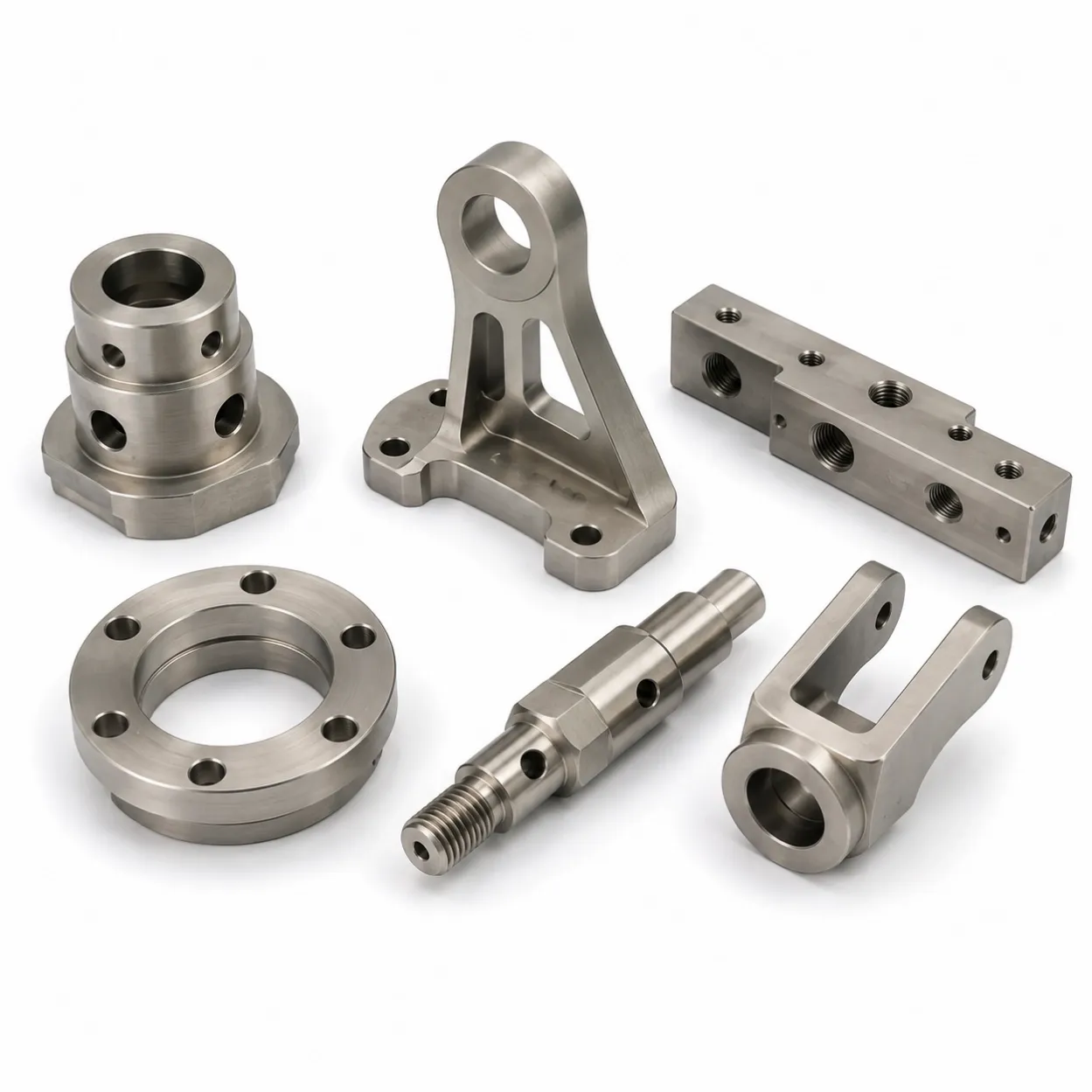
Titanium projects are manufactured according to the submitted drawing rather than a standard catalogue design.
Commonly reviewed component types include:
Mounting and Structural Components
Custom brackets, mounts, plates and structural components with drawing-defined holes, pockets, profiles and mating surfaces.
Bushings, Sleeves and Spacers
Turned or milled components with controlled outside diameters, bores, shoulders, grooves and assembly interfaces.
Housings and Functional Components
Drawing-specific components with pockets, mounting patterns, threads, bores, slots and other features required by the customer’s assembly.
Prototype and Replacement Components
One-off or low-volume parts manufactured from an approved file set for engineering evaluation, replacement requirements or repeat production.
Inspection and Documentation
Basic dimensional verification uses calipers, micrometers, depth gauges and height gauges.
Inspection records cover only the critical dimensions agreed from the drawing. YSBK does not have in-house CMM or optical inspection equipment.
Full-dimensional reports and CMM reports are not provided by default. First-part photographs and key-dimension records must be requested and agreed during the RFQ stage.
Material certificates and batch or heat-number traceability documents are issued by raw-material suppliers. Certificate and traceability requirements must be confirmed for every order during RFQ and are not automatically included with shipment.
YSBK reviews manufacturing feasibility against the customer-approved files. Material selection, design approval and validation of the completed assembly remain the customer’s responsibility.
Prototype and Repeat Production
MOQ is one part. YSBK reviews one-off titanium prototypes, engineering samples and low-volume production requirements.
A prototype may be used to evaluate geometry, fit or assembly before a repeat order. Manual adjustments made during prototype testing do not automatically become production requirements.
If the approved condition changes, the drawing and corresponding CAD file should be updated and approved before the repeat batch is released.
Quotation timing depends on drawing complexity, material sourcing, geometry, inspection requirements and the completeness of the submitted RFQ package.
What to Send for a Titanium Machining RFQ
Submit the following information:
- approved 2D drawing;
- matching STEP or 3D CAD file;
- part number and drawing revision;
- Titanium Grade 2 or Ti-6Al-4V Grade 5 designation;
- required stock or material condition, where applicable;
- prototype and production quantities;
- critical dimensions, fits, datums and tolerances;
- complete hole, bore and thread specifications;
- surface-condition and edge requirements;
- inspection points and required records;
- material certificate or traceability requirements;
- required delivery schedule; and
- confirmation of the file set that controls production.
A complete RFQ package allows material availability, machining feasibility and inspection scope to be reviewed before quotation.
Frequently Asked Questions
What titanium grades does YSBK machine?
YSBK reviews Titanium Grade 2 and Ti-6Al-4V Grade 5 projects from customer-approved drawings. Material availability and stock size must be confirmed for every order during RFQ.
Can you manufacture one titanium prototype?
Yes. MOQ is one part, subject to material, drawing, geometry and inspection review.
Can I request a quotation using only a STEP file?
A STEP file can support geometry review, but it may not define tolerances, datums, threads, fits, material condition or inspection requirements. Provide a controlled 2D drawing where these requirements apply.
Will YSBK substitute another titanium grade?
No titanium grade will be substituted without the customer’s written approval.
Is a titanium material certificate included?
Material certificates are issued by raw-material suppliers. Certificate and batch or heat-number traceability requirements must be confirmed during RFQ and are not included automatically.
Does YSBK provide CMM inspection reports?
YSBK does not have in-house CMM or optical inspection equipment. Full-dimensional and CMM reports are not provided by default. Required inspection records must be agreed before quotation.
What tolerances can be achieved on titanium parts?
Tolerance feasibility depends on the titanium grade, part size, wall thickness, feature geometry, stock removal, workholding and inspection condition. Identify critical dimensions and functional fits on the drawing for project-specific review.
Request a Titanium Machining Review
Send the approved drawing, STEP file, titanium grade, quantity, critical dimensions and inspection requirements.
YSBK will review the submitted manufacturing information and identify any points requiring clarification before quotation.