Sep 25, 2026CNC Machining Guides
Why “Titanium” Is Not Enough on a CNC Machining Drawing
Why a CNC machining drawing marked only “Titanium” is incomplete, and what engineers should confirm about Grade 2, Grade 5 and material documentation before RFQ.
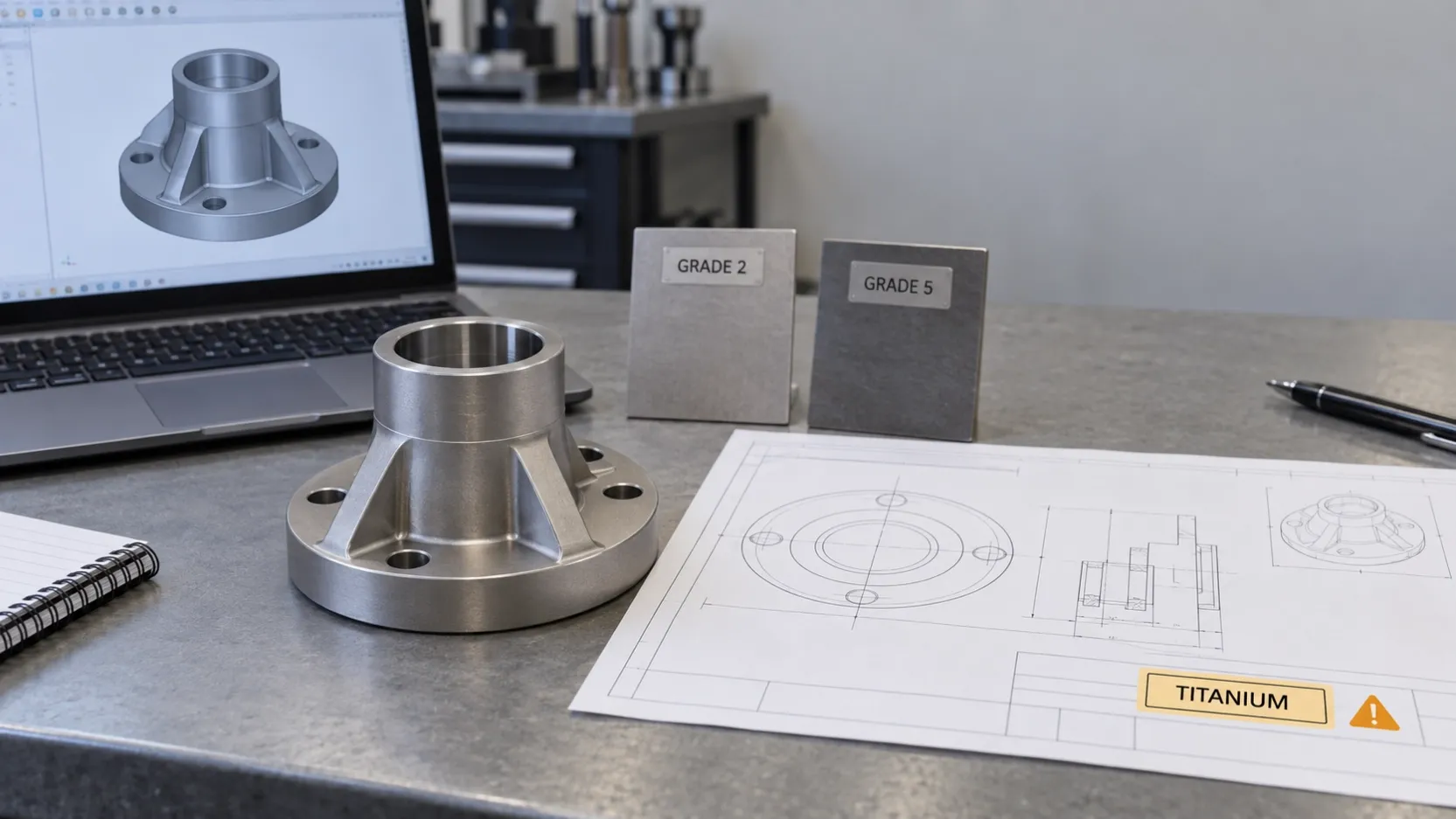
A titanium machining RFQ can include a drawing, STEP file and quantity yet still stop at material review because the title block says only “Titanium.”
That identifies a material family, but it does not define the material required for the finished part.
Before a machining supplier can prepare a useful quotation, the buyer should identify the titanium grade and any applicable material, condition or documentation requirements. Otherwise, the supplier is left to ask whether the part requires commercially pure Titanium Grade 2, Ti-6Al-4V Grade 5 or another project-specific grade.
The missing detail affects more than the material price. It can change stock availability, manufacturing review, inspection planning and the documents that must accompany the order.
“Titanium” Does Not Identify One Material
Titanium grades are not automatically interchangeable.
Titanium Grade 2 and Ti-6Al-4V Grade 5 differ in composition and mechanical properties. A part designed around one grade should not be quoted or manufactured from the other unless the customer’s engineering authority approves the change.
The machining supplier should not choose the grade based only on assumptions about the application.
Descriptions such as these remain incomplete:
- Titanium bracket;
- Titanium spacer;
- Titanium equivalent acceptable;
- Aerospace-grade titanium;
- Commercial titanium;
- Same titanium as the previous part.
The drawing or RFQ should identify the exact approved grade. If a governing material standard or supplied condition is important to the design, that requirement should also be stated.
Grade 2 and Grade 5 Require Separate Confirmation
YSBK machines Titanium Grade 2 and Ti-6Al-4V Grade 5.
Grade 5 jobs require per-order confirmation of material availability and part geometry before quotation. The ability to machine Grade 5 is not a blanket promise that every Grade 5 drawing can be quoted immediately.
For a Grade 5 enquiry, send:
- The current approved drawing;
- The matching CAD or STEP file;
- The complete material designation;
- The required quantity;
- Critical dimensions and functional features;
- Required material documents;
- The requested delivery schedule.
YSBK’s DFM & Quotation Engineer reviews the submitted geometry and sourcing requirements before confirming whether the project can be quoted.
The customer remains responsible for selecting and approving the titanium grade. YSBK does not substitute Grade 2 for Grade 5—or Grade 5 for Grade 2—without customer approval.
What the Material Callout Should Define
A useful titanium material callout should answer the questions that affect material purchasing and finished-part acceptance.
Depending on the project, this may include:
Requirement | What the buyer should state |
|---|---|
Titanium grade | Grade 2, Ti-6Al-4V Grade 5 or another approved designation |
Material standard | The governing specification, when required by the customer |
Supplied condition | The required condition when it affects the drawing or order |
Product form | Bar, plate, tube or another form when specifically controlled |
Substitution | Whether alternatives are prohibited or require written approval |
Documentation | Whether a material certificate or traceability information is required |
Not every project needs a long material note. The objective is to remove assumptions that would affect the quotation or acceptance of the finished parts.
If the drawing already contains the complete material requirement, the RFQ does not need to repeat it in several different places. It should, however, use the same revision and avoid introducing a conflicting description in the email, BOM or purchase order.
Do Not Put Conflicting Titanium Grades in Different Files
A common documentation problem is not simply a missing grade. It is a conflict between the drawing, BOM, STEP filename and purchasing note.
Examples include:
- The drawing specifies Grade 2, while the RFQ email asks for Grade 5;
- The BOM identifies Ti-6Al-4V, while the drawing says only “Titanium”;
- A previous quotation used Grade 2, but the revised purchase order does not identify the material;
- The filename contains “Gr5,” while the approved drawing specifies another grade.
The manufacturer should not decide which description overrides the others.
Before requesting a quotation, confirm that the drawing, BOM and purchasing instructions identify the same approved material. If a design change introduced a new titanium grade, update the controlled drawing revision rather than relying only on an email note.
The quotation should then identify the material basis used for pricing.
A STEP File Does Not Replace the Material Requirement
A STEP model helps communicate the geometry of a titanium part. It does not reliably communicate every purchasing and inspection requirement.
The model alone may not define:
- The titanium grade;
- The applicable material standard;
- The supplied condition;
- Whether substitution is allowed;
- Certificate requirements;
- Batch or heat-number traceability requirements;
- Critical tolerances and inspection notes.
These requirements should appear on the controlled drawing or in another approved purchasing document.
If your team is deciding what belongs in each file, see 2D Drawing vs 3D CAD for a CNC Prototype Quote.
Material Certificates Are Not Included Automatically
A material certificate and a traceability requirement are not implied simply because the drawing specifies titanium.
For YSBK orders:
- Material certificates are issued by the raw-material supplier;
- Certificates are not included automatically;
- Certificate requirements must be raised during the RFQ;
- Material certificates and batch or heat-number traceability are subject to per-order confirmation.
The availability of heat-number information depends on the material source and the documents available for that specific batch. YSBK therefore does not make a general promise that every titanium order will include heat or batch traceability.
If documentation is required, state the requirement before quotation. Do not wait until the parts have been manufactured or are ready for shipment.
A useful RFQ note would be:
Material certificate required. Batch or heat-number traceability to be confirmed before order placement.
This allows the sourcing and documentation requirement to be reviewed as part of the quoted scope.
What If the Titanium Grade Has Not Been Selected Yet?
YSBK can identify that the grade is missing, but it does not select the final material for the customer’s application.
Material selection may depend on load, corrosion exposure, temperature, weight, fatigue, mating materials, regulatory requirements and other design considerations outside the machining quotation.
If the grade has not been approved, the customer’s engineering team should resolve that decision before releasing the part for production.
A preliminary manufacturing discussion may still be possible when the geometry is available, but the final quotation should state the confirmed material basis. A price prepared against an assumed grade should not silently become approval to manufacture from that material.
YSBK’s review concerns manufacturability and quotation based on the submitted requirements. It does not certify the titanium grade as suitable for the customer’s complete product, machine or safety system.
Titanium Drawing Check Before RFQ
Before sending a titanium machining enquiry, check the following:
- Does the drawing identify the exact titanium grade?
- Is Grade 2, Grade 5 or another designation clearly stated?
- Is a governing material standard required?
- Does the BOM use the same material description as the drawing?
- Are the drawing and STEP files on the same revision?
- Is material substitution prohibited or subject to written approval?
- Is a material certificate required?
- Is batch or heat-number traceability required?
- Has the documentation requirement been raised before quotation?
- For Grade 5, have material availability and part geometry been submitted for per-order review?
This is not a complete CNC machining RFQ checklist. It is a material-definition check intended to prevent the quotation from being based on an unspecified titanium grade.
Request a Titanium Machining Review
YSBK manufactures drawing-defined parts in Titanium Grade 2 and Ti-6Al-4V Grade 5.
Grade 5 jobs require per-order confirmation of material availability and part geometry before quotation. Other titanium grades should not be assumed to be available without project-specific review.
Send your current drawing and matching STEP file with:
- The exact titanium grade;
- Quantity;
- Critical tolerances and mating features;
- Required material certificate or traceability scope;
- Surface or appearance requirements;
- Required delivery schedule.
YSBK’s DFM & Quotation Engineer will review the submitted information for manufacturing and quotation.
FAQ
Can I request a quote if the drawing only says “Titanium”?
You can submit the files for an initial review, but the exact grade must be confirmed before the material basis and final manufacturing scope can be established.
Does YSBK machine Titanium Grade 2?
Yes. YSBK machines Titanium Grade 2 from customer-approved drawings and CAD files.
Does YSBK machine Ti-6Al-4V Grade 5?
Yes, subject to per-order confirmation. Material availability and part geometry must be reviewed before quotation.
Can YSBK change Grade 2 to Grade 5 if Grade 5 is easier to source?
No automatic substitution should be assumed. Any material change requires customer review and approval.
Is a titanium material certificate included with every order?
No. Material certificates are issued by raw-material suppliers and are not included by default. The requirement must be confirmed during the RFQ.
Can YSBK guarantee batch or heat-number traceability?
Not as a general commitment. Material certificates and batch or heat-number traceability are subject to per-order confirmation based on the specific material source.