Packaging Custom Machined Parts: A Buyer’s RFQ Guide
Specify surface protection, corrosion controls, labels and carton quantities before ordering machined parts. Includes a 100-part packing example and an RFQ template.
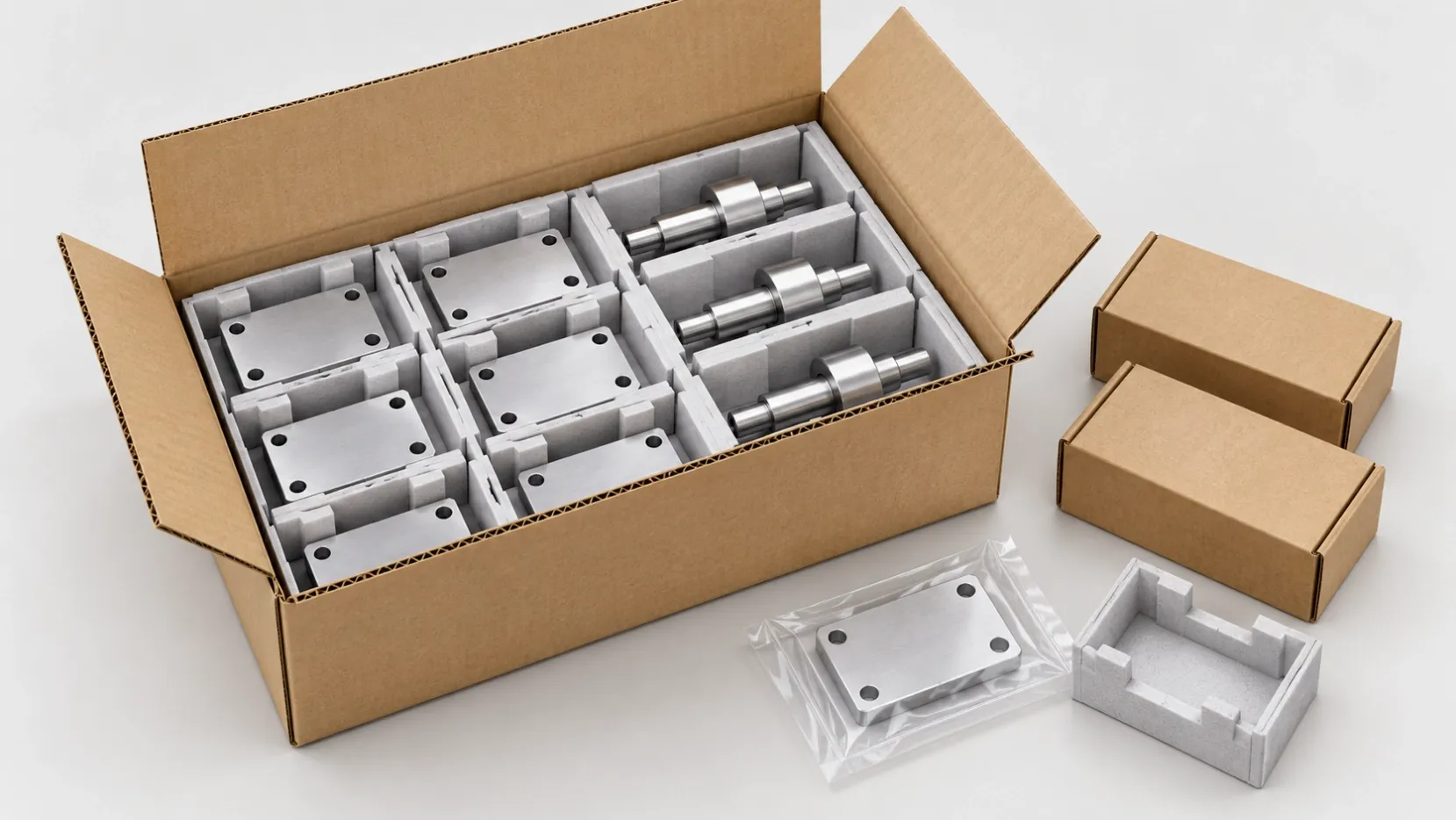
Packaging requirements for custom machined parts should explain how the parts must arrive: protected at the critical surfaces, identifiable by part number and revision, and organized for the buyer's next operation. Write those requirements into the RFQ before comparing prices.
For an assembly buyer, the next operation may be unpacking directly at a workstation. For a distributor, it may be placing counted inner packs into stock. For an online seller, it may be shipping one unit to a customer. Those are different packaging scopes, even when the component drawing is identical.
YSBK Parts manufactures custom components from approved drawings and CAD files. Request confirmation of the proposed packaging, availability, price and preparation time with your machining enquiry. Do not assume that individual bags, branded cartons, barcodes or special preservation are included.
What different buyers should ask the supplier to confirm
Buyer or use | Main purchasing concern | What to define in the RFQ |
|---|---|---|
Experienced wholesaler or distributor | Consistent counts, stock identification and repeat handling | Parts per inner pack, inners per carton, revision and lot identification, carton handling limit |
Trading company | Passing the customer's requirements through without omissions | Approved packing instruction and label artwork, destination, approval responsibility and permitted substitutions |
Online seller or store owner | Correct unit, contents and presentation | Units per sales pack, supplied accessories, buyer-approved SKU or barcode, transport packaging versus sales packaging |
Assembly or maintenance buyer | Damage, contamination and easy identification at use | Protected faces and features, acceptable residue, separate part numbers and any approved paired sets |
First-time buyer | Knowing what must be decided before ordering | A simple packing proposal, quoted options, example label and approval checkpoint |
A useful supplier response connects each request to a proposed method and identifies what needs approval. “Export packing included” does not explain whether finished parts can touch, what is inside each bag or how different revisions will be separated.
Mark the surfaces and features that need protection
Use a marked drawing or approved photograph to identify cosmetic faces, sealing tracks, locating surfaces, thin walls, projecting features, bores and threads that need particular protection.
Then agree on how parts will be separated and restrained. Possible methods include individual wrapping, sleeves, compatible separators, compartment trays or fitted supports. A bag may separate surfaces, but it does not by itself stop a heavy component moving inside a carton.
Contact materials also matter. Ask whether the proposed foam, paper, film, caps or adhesive could leave residue, abrade the finish or load a fragile feature. Specify any restrictions that affect subsequent assembly or finishing.
Carrier guidance is a useful starting point, not a complete part-specific packing design. For example, FedEx's parts-packing guidance addresses padding and protection for edges and protrusions. Confirm the packing method for the actual component and shipping route.
A worked packing example: 100 anodized mounting plates
Illustrative RFQ example only. These are invented product and packing details, not a YSBK customer case, a standard packing method or a validated transport design.
Assume an order contains 100 mounting plates, each 120 × 80 × 8 mm, with a specified black anodized finish and one cosmetic face. The buyer wants the same part number and revision throughout the shipment.
A proposed instruction could request compatible individual protection, separation so cosmetic faces cannot rub, five plates per inner pack and four inner packs per outer carton. The supplier must confirm suitable materials, restraint and carton capacity before this proposal is approved.
The count check is:
- 5 plates per inner pack × 4 inner packs = 20 plates per carton.
- 100 plates ÷ 20 = 5 cartons.
- 5 cartons × 4 inners = 20 inner packs in total.
That arithmetic confirms the proposed quantity structure. It does not establish carton strength, gross weight, cushioning performance or freedom from transit damage. Measure and weigh the proposed packed carton rather than estimating freight from the bare plate dimensions.
If only 98 plates are dispatched under an approved partial-shipment arrangement, label the actual quantities and reconcile the short carton on the packing list. Do not label every carton “20” merely because that was the original plan.
For a repeat order, reference a controlled packing instruction and revision. “Same as last time” is insufficient if the last shipment used a temporary arrangement or the part finish has changed.
Separate corrosion protection from scratch protection
A scratch-free part may still require protection against moisture or corrosion during transport and storage. State the material, surface condition, expected route, storage period and any restrictions on oil or other residues.
Where preservation is needed, ask for a proposed compatible method. Barrier materials, corrosion-inhibiting packaging, desiccants or protective fluids require selection for the actual part and conditions; none should be treated as a universal solution.
Confirm whether the buyer must remove a coating before use and whether that cleaning step is acceptable. Avoid vague instructions such as “rustproof for six months” without defined storage conditions and an agreed method of verification.
Define cleanliness in terms the supplier can check
“Clean packing” can mean different things to different buyers. Identify the contamination that matters: visible chips, loose particles, residual fluid, fingerprints on a cosmetic face or residue inside a passage.
Where the application requires a quantified cleanliness limit or a special cleaning process, provide the specification and agree on verification before ordering. Do not infer a validated cleanliness level from a sealed bag or a photograph.
Specify how openings should be protected where relevant, including whether closures must remain fitted during storage and who removes them before assembly.
Labels should help receiving, stocking and reordering
Agree on the information required at each level: individual unit, inner pack and outer carton. Depending on the order, useful fields can include the customer part number, drawing revision, PO reference, lot identifier and actual quantity.
For multi-part shipments, keep different part numbers and revisions distinguishable. If components are supplied as approved matched sets, preserve their pairing and identification through the packaging process.
For sales packs, provide approved SKU or barcode data and artwork. Confirm label placement, readability and any scanning check requested. A supplier should not invent product identifiers or compatibility claims for your listing.
Approve one label example before a larger batch is packed. Correct labels on the wrong revision remain a receiving problem, so link the packing list, package identification and production records as agreed.
Sales packaging and shipping packaging do different jobs
An individual bag or presentation box may suit storage and resale but still need an outer shipping package. Confirm whether the scope covers bulk delivery to your warehouse or shipment of individual orders to end customers.
Ask separately about instruction cards, accessory bags, branded printing and sales-pack assembly. These requests may need artwork approval, purchased materials, minimum purchase quantities or additional preparation time. Availability and charges need confirmation for the particular order.
For an early trial, consider requesting a simple approved arrangement before committing to custom packaging inventory. The right choice depends on your product, channel and expected reorder pattern.
Compare the full packing scope, not just the bag price
Ask each supplier to state what its quotation includes: protective materials, packing labor, inner and outer containers, labels, artwork preparation, purchased-material minimums and any special approval or testing work.
Also compare the estimated packed dimensions, gross weight and number of packages. UPS explains dimensional weight: package space can affect shipping charges. Use the selected carrier's current rules and a confirmed packing proposal rather than one universal divisor.
A smaller carton is not automatically better if it removes necessary protection. Equally, an oversized presentation package may add freight and storage work without helping the buyer. Compare the combined manufacturing, packing, transport and receiving scope.
The small-batch shipping guide covers transport choices; this article focuses on the packing requirements that must be settled before dispatch.
Approve a packing example before the shipment is closed
For a new part or packing method, request an example showing how the component is protected, how an inner pack is counted and how the outer label matches the packing list. Confirm whether photographs, a physical packing sample or a defined transport test are required, available and included in the quotation.
Photographs can document the visible arrangement. They do not prove hidden cleanliness, corrosion resistance, complete shipment quantity or performance during transport. Agree on the evidence appropriate to the risks.
At receiving, record shortages or damage with the affected part numbers, carton identifiers and photographs, and retain relevant packing materials where practical. Discuss the discrepancy with the supplier using the agreed acceptance and order terms. Do not return damaged parts to usable stock before assessment.
A packaging request you can add to your machining RFQ
“Please quote [part number and drawing revision], quantity [number], with packaging for [assembly / warehouse stock / resale]. Protect [identified surfaces and features] and propose compatible separation and restraint. Confirm [units per inner pack], [inners per carton], label fields, any preservation or cleanliness requirements, and the packing-approval step. State included and optional costs, preparation-time effects, estimated packed dimensions and gross weight. Confirm open points before manufacture or packing; no unapproved substitutions.”
Attach the approved drawings and CAD files, destination, expected shipping method, storage needs and any buyer packing instruction or artwork. If these are not yet defined, ask the supplier which decisions are needed to prepare a comparable quote.
Questions buyers ask before ordering
Is individual bagging always necessary?
No. Select protection for the part's finish, geometry and use. Some parts need individual separation; other approved bulk arrangements may be suitable. Confirm the method rather than assuming that a bag alone provides sufficient protection.
Does “export packaging” include retail labels?
Do not assume so. Define the sales unit, label data, artwork, accessories and approval requirements, and ask whether that scope is available and separately charged.
Can packaging affect the delivery date?
It can. Artwork approval, purchased materials, special containers or packing trials may add preparation steps. Ask how the proposed scope affects the quoted dispatch schedule.
What should I request for repeat orders?
Reference the approved part and packing revisions, quantities and label requirements. Confirm any change in the part, finish, route or storage conditions that could require a packing review.
Request parts with a clear packing scope
For repeat batches to approved drawings, explore low-volume CNC machining.
Send your machining and packaging enquiry with the drawings, quantity, finish and destination. Explain whether the parts are for assembly, stock or resale, and request confirmation of the packing method, charges and approval requirements with the quotation.