CNC Machining Guides
Vacuum Casting vs CNC Machining: How to Choose for Plastic Prototype Parts
Classify six requirements as Must-have or Preference, record your preliminary process choice and open questions, then confirm the final process after written quotes.
You have a plastic part drawn in CAD, a prototype round to schedule, and two candidate processes that quote from completely different assumptions. This guide is for engineers and procurement leads choosing between vacuum casting and CNC machining for one specific plastic prototype or low-volume part. It is not for injection-molding production quantities, metal-only parts, or shoppers comparing prices across suppliers — those need different pages. Six dimensions plus written supplier confirmations beat instinct when two processes quote from different assumptions. Score your part on quantity, tolerance, material, geometry, surface finish and timeline, mark each requirement as Must-have or Preference, and record a preliminary preference, a fallback candidate and every unresolved supplier question before the RFQ goes out — the final primary and fallback processes are confirmed only after the written quotations arrive.
Why this decision goes wrong before quotes arrive
- The engineer or procurement lead who owns the part has to get physical prototypes made.
- The drawing is finished, and both vacuum casting and CNC machining sit on the candidate list.
- Neither the drawing nor the RFQ states which process the part was designed for, so each shop quotes its own process assumption and the quotes cannot be compared like for like.
- Clarification emails, re-quotes and re-tests can then bounce between shops while the schedule slips.
- The prototype round may land later and cost more than planned — or the cheaper quote wins on price alone and the part fails at the dimension nobody checked.
- The decision this page owns: score the six dimensions, classify each requirement as Must-have or Preference, and record a preliminary preference, fallback candidate and open questions before any quote goes out; the final primary and fallback are confirmed after written responses arrive.
Two processes, two opposite mechanisms
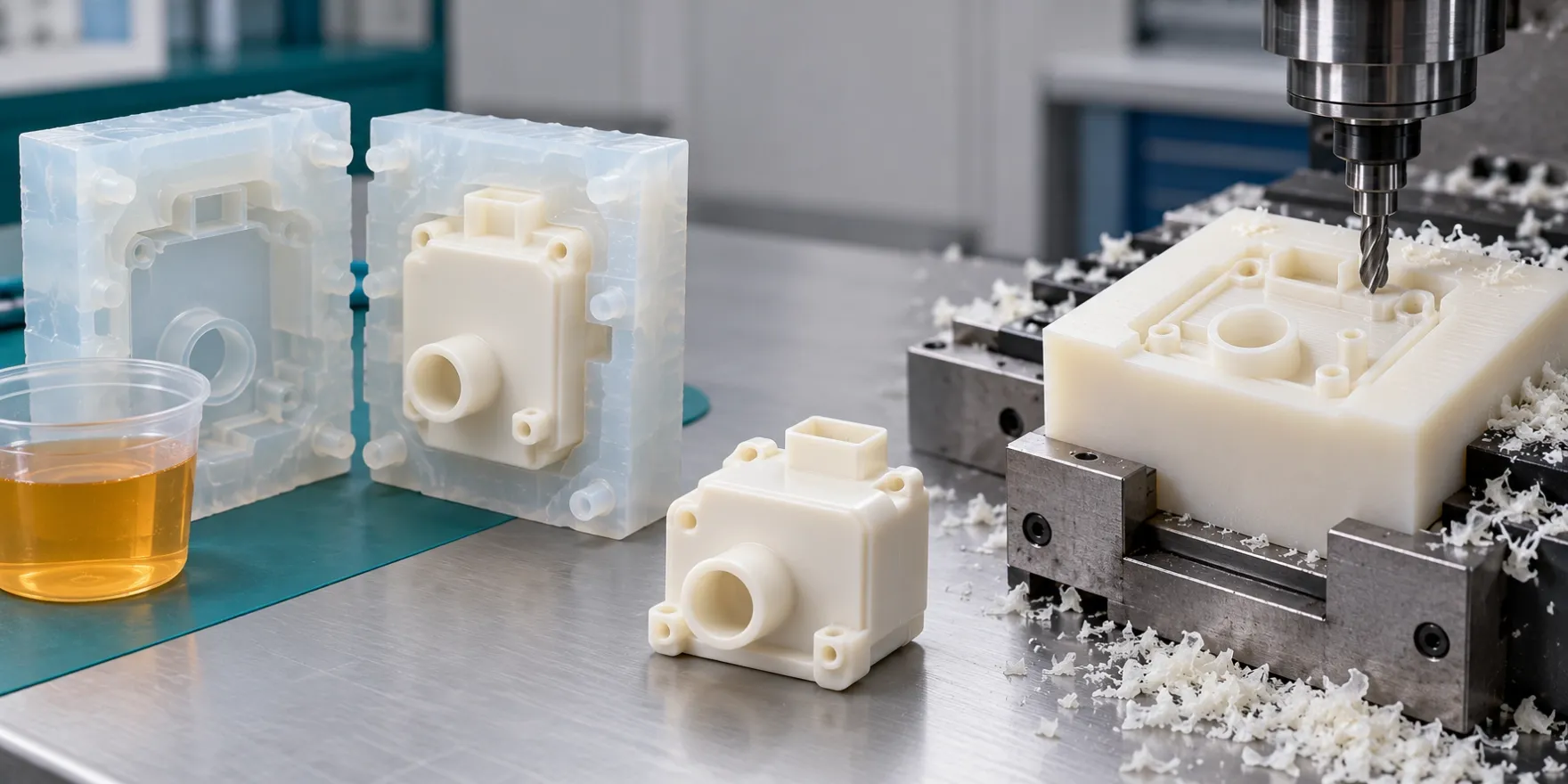
Vacuum casting and CNC machining arrive at the same plastic part through opposite routes. Vacuum casting starts with a master pattern — often CNC-machined or 3D-printed — wraps it in a silicone mold, and then pulls copies from casting resin. Casting copies one part many times once the tooling exists, while CNC cuts every part individually from solid stock, which is why the same drawing behaves differently in each quote.
That mechanism difference drives the cost structures. Casting requires a master pattern and silicone mold before the first copy exists, so mold count and expected mold life become planning variables that only the supplier can confirm for a specific part. CNC does not require a silicone mold, but programming, workholding, setup and inspection costs still apply. Whether CNC work can start quickly also depends on material availability, programming, fixturing and inspection requirements — treat the start date as an RFQ question, not an assumption.
Neither route is "better". They win on different rows of your part's requirement list, which is what the next section scores.
Six dimensions that decide the call
Score your part on each dimension before looking at any quote.
Quantity
Quantity shifts which cost structure wins, but where the tipping point sits is part-specific — it moves with part size, resin, mold structure, surface requirements and mold wear, so no universal unit count applies. For a small number of purely functional units, CNC usually avoids tooling that would never be amortized. At moderate quantities, casting may pull ahead — or may not, if your part requires multiple molds. Put your unit count and part size to the supplier and ask two questions in writing: how many molds does my quantity imply, and what mold life do you expect.
Tolerance and inspection
Tolerance decides whether casting can hold the part at all: assembly-critical fits stay on the CNC side unless the casting supplier confirms otherwise in writing. Casting accuracy is inherited from the master pattern, the silicone mold, resin behavior and hand trimming; the full chain is explained in the casting tolerance guide linked below, so only the decision view is repeated here. CNC is generally the better fit for tighter tolerances, but the achievable tolerance still depends on material, geometry, workholding and inspection conditions.
One clarification buyers often need: casting parts can be measured with a CMM — measurement itself is not the barrier. The real questions are whether the casting can hold your specified tolerances, and whether the supplier will provide the dimensional report you require. Until both are answered in writing, treat that row as unconfirmed.
Material
CNC machining can produce the part from the specified production plastic when the exact grade, stock form and required size are commercially available; material availability must be confirmed during the RFQ. Casting uses polyurethane resins formulated to approximate different production plastics. Resin equivalence to your production material must be confirmed in writing under actual processing conditions — no resin substitutes automatically. If the prototype must be the production plastic itself, that row leans CNC until a named resin substitution is confirmed; if it only needs to behave similarly for a design review, a confirmed resin may be enough.
Geometry
Vacuum casting can reproduce some undercuts and shapes that are difficult to machine, provided the master pattern, parting strategy and mold-release plan are suitable. Enclosed or difficult-to-release features may still require inserts, parting-line changes or design adjustments. CNC needs tool access to every surface it cuts, so deep pockets and thin walls raise cost and risk. Describe the feature, not just the material, when you score this row.
Surface finish
Vacuum casting can reproduce the master pattern's surface and can support painted or textured appearance parts, but parting lines, gates, trimming and hand finishing must be reviewed. CNC-machined surfaces may show tool marks unless a separate finishing requirement is specified. If buyers or reviewers will hold the part in their hands, weigh this row explicitly.
Timeline
Casting has to build the master pattern and silicone mold before the first copy exists, so it suits a date that can absorb mold build when several copies are needed anyway. CNC suits smaller batches where skipping the mold helps and material plus machine scheduling are confirmed. On either route the final date is confirmed by quotation — never assumed.
Where your rows point at both processes, confirm what each side actually covers before you commit: Review the CNC machining service scope behind the CNC side of this comparison, and Review the vacuum casting parts category behind the casting side of this comparison.
Score your part: the decision table
Mark each requirement as Must-have or Preference, then enter Casting, CNC, or Depends in the last column — before comparing any quote.
Dimension | Leans vacuum casting when… | Leans CNC when… | Must-have or Preference? | Your verdict |
|---|---|---|---|---|
Quantity | moderate counts, with mold count and mold life confirmed to cover it | small functional batches where tooling would never amortize | | |
Tolerance & inspection | casting holds your tolerances and the required report is confirmed in writing | assembly-critical fits are tight, or report scope is unconfirmed | | |
Material | a named resin substitution is confirmed in writing | the part must be the production plastic itself | | |
Geometry | undercuts or molded geometry can be reproduced reliably and the mold-release plan is confirmed | critical features are accessible to cutting tools and can be produced from available stock without impractical deep or thin-wall machining | | |
Surface finish | visible appearance part, molded surface with parting lines and finishing reviewed | functional part where tool marks are acceptable | | |
Timeline | the needed date allows building the master pattern and silicone mold, and multiple copies are needed | the batch is small, no mold is needed, and material plus machine scheduling are confirmed | | |
Decision rules
- Mark each requirement as either Must-have or Preference before comparing the processes.
- A process cannot be selected while a Must-have requirement remains unconfirmed. It is eliminated only when the supplier confirms that the requirement cannot be met.
- Material identity, assembly-critical tolerances, inspection records, required delivery date and geometry feasibility can all become Must-have requirements.
- If both processes remain feasible, compare the Preference rows together with the quoted material, tooling, finishing, inspection, quantity and delivery scope.
- Do not choose a process by counting rows alone — one Must-have requirement can outweigh several preferences.
- Record any unresolved item as Depends and turn it into a written RFQ question.
- If neither process has all Must-have requirements confirmed, revise the design, consider a hybrid process or evaluate another manufacturing route.
Worked example (illustrative)
This example is illustrative, not a customer part. The capability outcomes are hypothetical and shown only to demonstrate the rules.
Part: a sensor housing, 30 units, prototypes for a design review. Assembly-critical feature: a bearing bore specified at ±0.05 mm that must arrive with a dimensional report. Production intent is ABS. Outer faces are visible. The parts are needed ahead of a trade-show demo.
Dimension | Class | Entry | Reasoning |
|---|---|---|---|
Quantity | Preference | Depends | moderate count; mold count and mold life must be quoted for this part size |
Tolerance & inspection | Must-have | unconfirmed — casting cannot be selected as drawn | no written casting confirmation for the ±0.05 mm bore plus report, so the Must-have requirement is still open |
Material | Preference | Depends | ABS may map to a casting resin, but that needs written confirmation |
Geometry | Preference | leans casting | ribs and a recessed pocket favor a molded copy, with the mold-release plan reviewed |
Surface finish | Preference | leans casting | visible consumer faces, parting lines and finishing to be reviewed |
Timeline | Preference | Depends | the demo date must absorb mold build — quote to confirm |
Conclusion: vacuum casting is not currently eligible because the required tolerance and dimensional report have not been confirmed. CNC machining becomes the preliminary preferred route, but it is not finally approved until the CNC supplier confirms the ±0.05 mm bearing bore, inspection method, dimensional report, material availability and delivery date in writing. A conditional alternative is vacuum casting followed by secondary machining of the bearing bore. That route remains unconfirmed until a supplier accepts the machining allowance, workholding method, achievable tolerance, inspection scope and effect of secondary machining on the cast part. The buyer sends these unresolved requirements with the RFQ and records the final primary and fallback processes only after the written responses are reviewed.
Boundaries to check before you record the decision
Material equivalence is a boundary, not a given: a casting resin that looks close to your production plastic is not that material unless the supplier confirms the substitution in writing, under your actual processing conditions. Resin data sheets normally report typical test results under defined conditions; they do not by themselves guarantee that a finished cast part will match the production plastic or meet the application requirements.
A price-only process choice can win the quote and fail the part. A cheaper casting quote means little if a Must-have requirement is still unconfirmed or has been ruled out. The table protects you only if every requirement is classified before the numbers arrive.
Tolerance is the row buyers most often under-verify. Check how vacuum casting tolerances are defined before you lock the tolerance row of your decision — it explains how the master pattern, silicone mold, resin behavior and trimming each add deviation, and what to state on the drawing so a casting quote is checkable.
One scope boundary: this decision assumes a prototype or low-volume round. If the part is heading toward injection-molding production quantities, tooling economics change completely and this table does not apply.
Record your decision
Complete this pre-RFQ record for one part number, then attach it to the drawing package.
Field | Your entry |
|---|---|
Quantity (units for this round) | |
Assembly-critical tolerance and required report | |
Production material / resin question for the supplier | |
Geometry features noted | |
Surface finish expectation | |
Needed date | |
Must-have unmet? (requirement / process / none) | |
Preference summary and unresolved questions | |
Preliminary primary process | |
Fallback candidate and its written-confirmation condition | |
Before sending the RFQ, record a preliminary process preference, a possible fallback and every unresolved supplier question. Confirm the final primary and fallback processes only after the quotations and written supplier responses have been reviewed. Nothing on this page is submitted, collected or stored. Attach the completed record to the drawing package so every shop quotes from the same classified requirement list, and the quotations become easier to compare on a more consistent scope.