Manufacturing Process Guides
3D Printing vs Vacuum Casting: Print Every Part or Make a Mold?
Compare direct 3D printing with vacuum casting for a plastic preseries batch. Classify Must-haves, normalize quote scope, and record a primary route, fallback and switch condition.
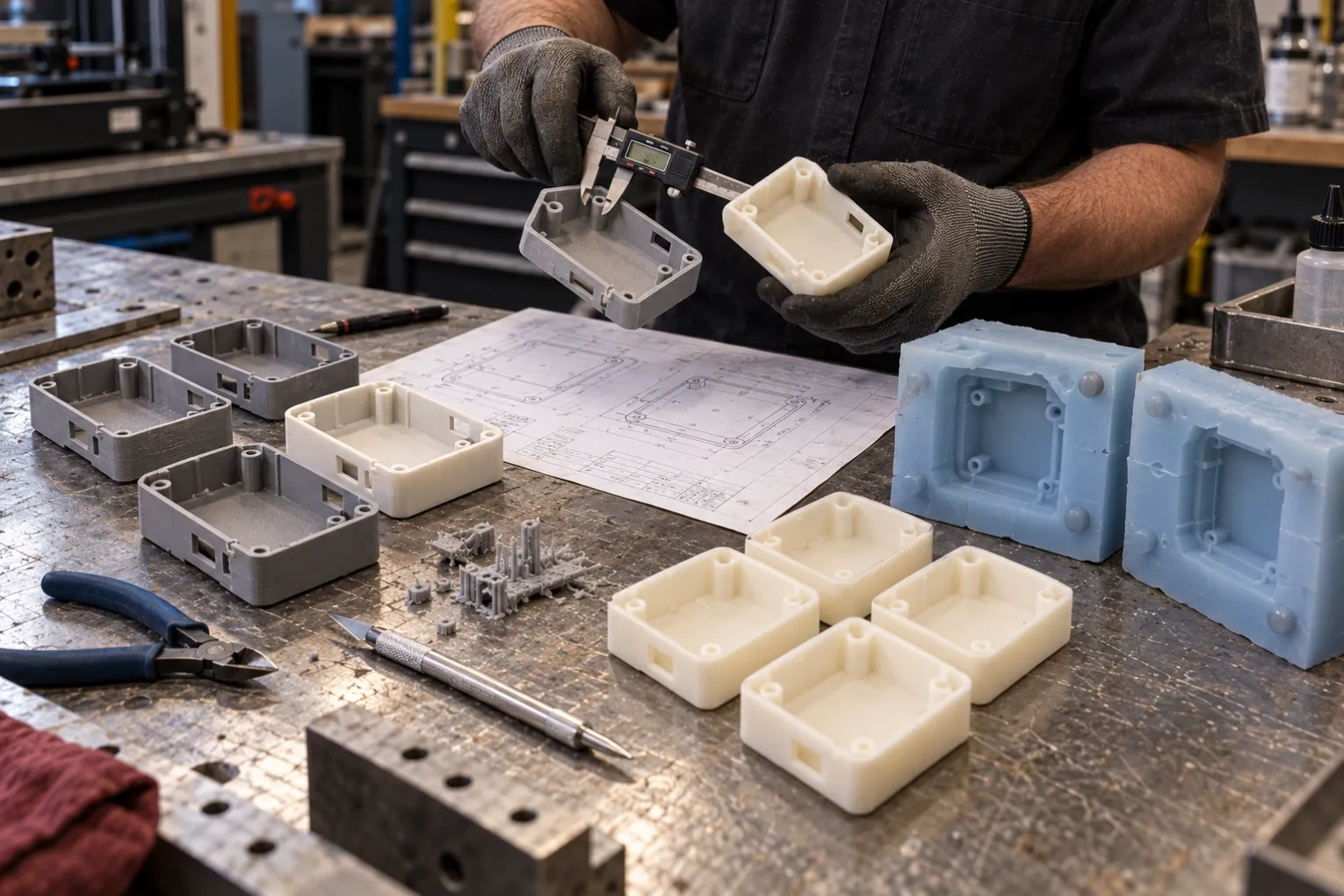
This page helps engineers and procurement teams decide one thing for a plastic preseries batch: whether to print the entire batch directly, or produce an approved master and reproduce the batch through one or more silicone molds.
It is written before any RFQ goes out, for teams that already have a released CAD model, a drawing package and a target quantity. It is not for single one-off concept models, metal parts, injection-molding production quantities or price shopping across suppliers.
A vacuum casting master may itself be 3D-printed or machined, so this is not simply printing versus casting. It is print every part versus approve a master and replicate the batch. The right answer depends on requirements that suppliers must confirm in writing.
The result is a decision record containing:
- a preliminary primary route;
- a fallback candidate;
- the condition that allows the project to switch to the fallback; and
- the open questions attached to the RFQ.
The Decision This Page Owns
Two routes may be candidates for supplying the same preseries requirement.
Route A — print the whole batch. Every part is built individually on the printing platform. No silicone mold is used.
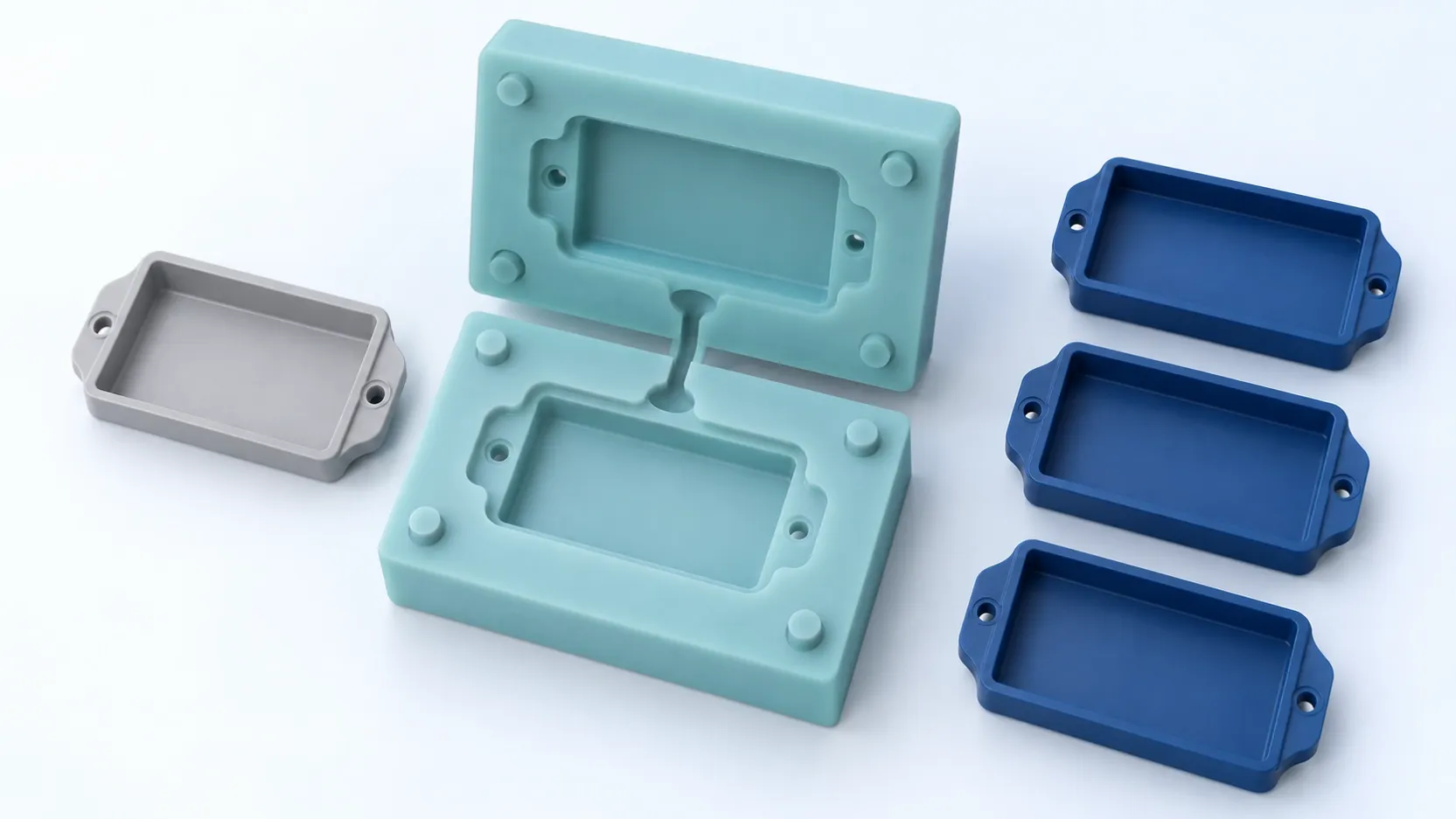
Route B — approve a master, then produce copies. A master pattern, which may itself be 3D-printed or machined, is used to make one or more silicone molds. Polyurethane copies are then cast from those molds.
Both routes may be reviewed from the same released CAD and drawing package, but each quotation must identify its own material, finishing, inspection, tooling and delivery scope. The decision is not which technology is universally better. It is which route's commercial structure, quality chain and schedule fit this batch.
Why the Quotes Are Not Comparable Until the Scope Is Normalized
A Route A quote covers individually printed parts together with the stated finishing and inspection. A Route B quote may cover master preparation, master approval, mold making, cast copies, finishing and inspection.
Those are different scopes with different quality chains. Printed parts may vary with build position, orientation and finishing. Cast parts reproduce the approved master but are also affected by mold condition, resin preparation, trimming and finishing.
Comparing totals before normalizing the scope can hide differences in:
- printing material or casting-resin identity;
- master preparation and approval method;
- whether approval is based on a physical sample, photographs or a dimensional report;
- whether mold making may begin before master approval is recorded;
- the number of molds included;
- expected usable copies per mold and the replacement-mold condition;
- finishing requirements;
- critical dimensions; and
- inspection records.
Classify the requirements before comparing commercial terms.
Apply Two Common Veto Rules First
Tolerance and material are two common vetoes, but they are not the only possible Must-have requirements. Geometry, appearance or delivery can also eliminate a route when the requirement is mandatory and the supplier confirms that it cannot be met.
An unanswered Must-have does not automatically eliminate a route. It makes the route unselectable until the supplier responds in writing.
Tolerance and Inspection Veto
If an assembly-critical dimension requires a tolerance and inspection record that a supplier has not confirmed in writing for a route, that route cannot be selected while the requirement remains open.
The route is eliminated only if the supplier confirms that the requirement cannot be met. Both printed and cast parts are subject to part-specific, supplier-confirmed tolerances, so this veto applies equally to both routes.
For every critical characteristic, confirm:
- the tolerance;
- the inspection stage;
- the measurement method;
- the sample quantity; and
- whether actual measured values will ship with the batch.
Turn every open dimension or reporting requirement into a written RFQ question.
Material Veto
Route A uses a process-specific printing material. Route B uses a casting resin. Neither should be treated as the production plastic unless the supplier confirms the exact material identity and processing condition in writing.
Matching a polymer-family name does not by itself confirm equivalent finished-part properties. Where performance matters, record the required property, test condition and acceptance basis rather than relying only on names such as “PA12” or “ABS-like.”
If the batch must use the production plastic itself and that identity cannot be confirmed, the route cannot be selected. If a substitute is acceptable, record:
- which properties the substitute must represent;
- what supporting data is required;
- the test or comparison basis, where applicable; and
- who is authorized to approve the substitution.
A route with an open veto is not necessarily worse. It is simply not selectable yet.
Classify and Compare the Four Routing Factors
Quantity, geometry, appearance and timeline are routing factors, not automatic preferences. Classify each one as either Must-have or Preference for the actual batch.
If a supplier confirms that a Must-have geometry, appearance or delivery requirement cannot be met, that route is eliminated. If the point remains unanswered, the route remains unselectable rather than eliminated. Do not decide by counting rows; one Must-have can outweigh several preferences.
Quantity
Quantity alone does not decide the route.
Route A produces and finishes each part. Route B adds master and mold work before copying begins, so its commercial position depends on how those setup costs are distributed across the quoted batch.
The balance moves with part size, resin, mold structure, finishing and expected mold life. Ask one or more capable suppliers to quote a direct-print scope and a master-plus-casting scope, then compare them only after every Must-have has been confirmed.
Geometry
Route A avoids mold-release constraints, so some internal channels and trapped features may be more practical to print. Support removal, resin drainage, powder removal and inspection access still need review.
Route B adds a release cycle. Enclosed or difficult-to-release features may require parting-line changes, inserts or design adjustment. If the master is printed first, support placement and master finishing also become part of the Route B quality chain.
If a required feature cannot be printed, cleaned, released, finished or inspected, geometry becomes a veto rather than a preference.
Appearance Consistency
Route B can reproduce an approved master surface across the batch, but mold wear, trimming, color preparation and finishing can still introduce variation.
Define whether the master is approved by physical sample, photographs or dimensional report, which surfaces and characteristics the approval covers, and whether mold production may begin before that approval is recorded. Also define the acceptable appearance range for the cast copies.
Route A produces parts in separate builds or build positions. If appearance consistency matters, define the finishing process and approval reference rather than assuming that every printed part will match automatically.
Timeline
Route A does not require master and silicone-mold preparation, but material availability, build scheduling, finishing and inspection still require quotation confirmation.
Route B adds master preparation, master approval and mold making before the first copy exists. The required date must account for those stages.
If the delivery date cannot move, timeline is a Must-have. The delivery date for either route is confirmed by quotation, never assumed.
Where the factors point both ways, review the verified 3D printing service scope, check the current vacuum casting parts listing, and use the vacuum casting versus CNC comparison if machining is also under consideration.
A 25-Unit Example, Decided Conditionally
This example is illustrative, not a customer part. The requirements and outcome are hypothetical and demonstrate the decision rules.
A team needs 25 device enclosures for a sales tour. The parts have visible faces, an ABS-like behavior requirement and one assembly-critical rib carrying an illustrative drawing requirement of ±0.30 mm. An actual-value measurement record is required for that rib on an agreed sample quantity, followed by the buyer's incoming check on arrival. The target delivery date is three weeks and cannot move.
Veto Check: Tolerance and Inspection
For either route, the supplier must confirm the rib tolerance, inspection stage, measurement method, sample quantity and whether actual measured values will ship with the batch.
The requirement is unresolved for both routes, so neither route is eliminated. Both remain unselectable until the required confirmation arrives.
If the rib cannot be held as cast under Route B, the buyer should ask whether a defined secondary machining operation can be quoted, including machining allowance, workholding, achievable tolerance and inspection scope.
Veto Check: Material
“ABS-like” describes the team's intent but does not identify the delivered material or guarantee finished-part behavior.
Each supplier must identify the proposed printing material or casting resin, explain which required properties it is intended to represent, state the relevant test conditions and provide the agreed supporting data. The team must record who is authorized to approve the substitution.
Routing-Factor Check
Quantity — Preference. At 25 units, quantity alone does not decide the route. Both normalized scopes are requested.
Geometry — Preference. The outer shell and mild ribbing may suit molding with a reviewed release plan, while Route A avoids silicone-mold release constraints. Slight preference toward Route B, subject to review.
Appearance — High-weight Preference. Visible faces across the demonstration batch favor an approved master surface. Route B must define the master-approval method, approval milestone and acceptable appearance range.
Timeline — Must-have. The three-week date must absorb master approval and mold making if Route B is selected. Route A must separately confirm material, build, finishing and inspection milestones. Neither route can be selected until its delivery commitment is confirmed in writing.
Preliminary Decision Record
Quantity alone does not decide the route at 25 units. Vacuum casting is the preliminary preference because the batch places a high priority on consistent visible surfaces, provided the supplier confirms the assembly-critical rib and its inspection record, the proposed resin substitution, the master-approval and mold plan, the finishing scope and the required milestones in writing.
Direct 3D printing is the fallback candidate only if it independently confirms the same Must-have tolerance, inspection, material-substitution and delivery requirements, together with an acceptable appearance and finishing scope.
Switch to direct printing only if a mandatory Route B confirmation fails while every Must-have for Route A remains confirmed. If neither route confirms every Must-have, do not award the batch to either route.
That decision record, together with the open questions, is attached to the released drawing package.
Turn the Result Into One RFQ Decision Line
A usable decision record names four things:
- the preliminary primary route;
- the fallback candidate;
- the condition that permits the switch; and
- the open questions each supplier must answer in writing.
For the example:
Preliminary primary route: vacuum casting, conditional on written confirmation of the critical rib and actual-value inspection record, proposed resin substitution, master-approval method, number of molds or mold plan, finishing scope and required milestones.Fallback candidate: direct 3D printing, conditional on separate written confirmation of the same Must-have tolerance, inspection, material and delivery requirements, together with the required appearance and finishing scope.Switch condition: use the fallback only if a mandatory Route B confirmation fails while all Route A Must-haves remain confirmed. If neither route passes, return the project for design, requirement or process review.
Nothing is collected or submitted by this page. The record stays with the buyer, and each supplier quotes against the same classified requirement list.
Record Your Decision
Complete one record for each part number and drawing revision.
Field | Your entry |
|---|---|
Part number and drawing revision | |
Released CAD and drawing files | |
Batch quantity | |
Tolerance veto: critical dimensions, inspection stage, method, sample and records | |
Material veto: production plastic required or substitution acceptable | |
Required material properties, test conditions and approval owner | |
Geometry, cleaning, release and inspection-access notes | |
Appearance requirement and approval reference | |
Needed date and required milestones | |
Route A material, finishing, inspection and delivery confirmations | |
Route B master-approval method, mold plan, expected copies and replacement condition | |
Preliminary primary route | |
Fallback candidate and its independent confirmations | |
Switch condition | |
Open questions requiring written answers | |
Attach the completed record to the released CAD file and 2D drawing so every supplier quotes the same revision, material intent, critical requirements, finishing scope and inspection request.
If Neither Route Passes
If neither route has every Must-have confirmed after the written responses arrive, do not force a winner.
Revise the design, add a defined secondary operation, split the validation batch from the preseries batch, or evaluate another manufacturing route. The decision record remains attached to the drawing package either way.
Send a Comparable RFQ
If your files are ready, send the released CAD model and 2D drawing together with the batch quantity, critical dimensions, material intent, appearance requirement, inspection records and required date. Ask each supplier to state its assumptions, exclusions and open points in writing so the two routes can be compared on the same requirement set.