CNC Machining Guides
CNC Machining Finishes: Anodizing, Plating, Powder Coating & Passivation
Match CNC part finishes to real requirements: anodizing for aluminum, plating for conductivity, powder coat for color and impact, passivation for stainless — with RFQ-ready specification lines.
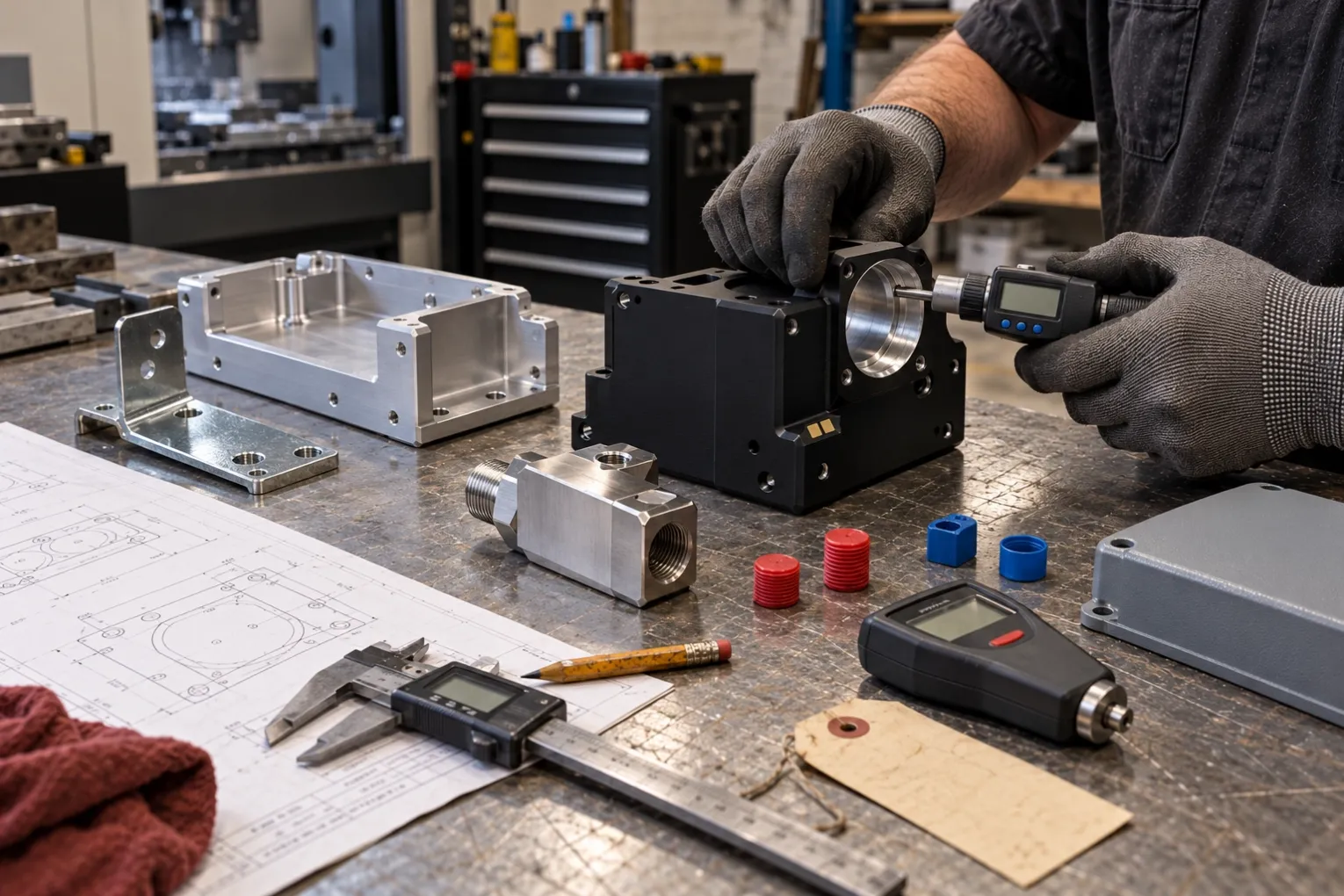
Anodize, plate, powder coat or passivate — four finishes, four different protection mechanisms, and a quote that changes completely depending on which one you pick. This guide is for engineers and procurement leads choosing a finish for CNC machined metal parts, before the RFQ goes out. It is not for high-volume decorative consumer products, for plastic parts, or for buyers who already have a finish spec from their customer. It is a matching exercise: start from the environment and function your part must survive, eliminate the finishes that cannot provide it, and write the chosen finish — with its masking and inspection scope — into the RFQ as a line item. The completed finish line travels with your drawing, so every shop quotes the same protection.
Why finish choices go wrong
- The engineer finishes a machined part and must state the finish on the RFQ — with no time to research corrosion mechanisms.
- The RFQ says "anodize" for an aluminum part that later gets mounted against steel in a wet environment — galvanic corrosion risk nobody flagged at quotation.
- Each fabricator fills the gap differently: one quotes clear anodize, one quotes powder coat, a third asks why any finish at all.
- The quotes arrive in different scopes and cannot be compared.
- The parts arrive, and the finish fails in the field — or the added coating thickness pushes a critical fit out of tolerance.
- The decision this guide owns: define the operating environment and function, eliminate the finishes that cannot provide it, and write the chosen finish — with its masking and inspection scope — into the RFQ as a line item.
The finish menu — what each one actually does
Anodizing (Type II / Type III)
Anodizing — primarily for aluminum. An electrochemical process that converts the aluminum surface into an oxide coating. Part of the base material is consumed and part of the coating builds outward, so bores, threads and close fits can change. Under MIL-PRF-8625 terminology, Type II is conventional sulfuric-acid anodizing and Type III is hard anodizing; the required type, class, thickness, sealing, color and applicable standard must be stated rather than inferred.
Plating (electroplating)
Plating — a family of metallic coatings, not one interchangeable option. Zinc, electrolytic nickel, electroless nickel and chromium coatings serve different purposes and follow different specifications. State the exact deposit or approved standard, substrate and heat-treatment condition, required thickness, post-treatment, critical dimensions and inspection scope. For high-strength steel, the RFQ must also address hydrogen-embrittlement risk and any required pre- or post-coating treatment.
Powder coating
Powder coating — a comparatively thick colored barrier coating. It can provide a durable decorative and protective finish, but corrosion and mechanical performance depend on the substrate preparation, pretreatment, powder system, film thickness and cure. State the color, texture or gloss, masking zones, permitted film-thickness range and any required performance test.
Passivation
Stainless-steel passivation. In this guide, passivation means a chemical treatment for stainless-steel parts that removes contaminating free iron and supports formation of the passive surface condition. It is not a decorative colored coating and is not specified by a build thickness like plating or powder coating. State the applicable standard, treatment or test requirement where necessary.
Two veto rules before comparing
Substrate veto. Anodizing applies to aluminum and applicable nonferrous alloys; passivation applies to stainless steel; powder coating and plating cover a wider substrate range. Match the finish to the base material first — a finish that cannot form on your alloy is out regardless of its other benefits.
Dimensional veto. Finishes do not affect dimensions in the same way. Plating and powder coating build an external layer; anodizing consumes part of the aluminum surface while part of the oxide grows outward; stainless-steel passivation does not create a specified build thickness in the same sense. For every assembly-critical fit, state whether the drawing dimensions apply before or after finishing, define the permitted coating range where relevant, and identify any surfaces that require masking. A finish route is not selectable until its dimensional effect is confirmed within the tolerance band.
Match finish to requirement, not to habit
If your part… | The finish that covers it |
|---|---|
is aluminum with corrosion exposure | anodizing (Type II cosmetic / Type III wear) |
needs to transmit light or look transparent-clear | SLA clear resin or bare polished metal — anodize and powder coat are opaque |
is steel with outdoor corrosion exposure | zinc or nickel plating, or powder coat |
needs electrical conductivity at the contact points | plating, or mask the contact points from insulating finishes |
is stainless needing surface improvement | passivation |
needs thick, impact-resistant, colored protection | powder coating |
Worked example (illustrative)
An aluminum enclosure: outdoor installation, one grounding point must remain electrically conductive, mounting holes with tight fits, possible contact with dissimilar-metal hardware, 10 units.
- Substrate — aluminum: anodizing is a candidate, subject to confirmation of the exact alloy and the finishing supplier’s process capability. Stainless-steel passivation does not apply. Anodizing remains under consideration.
- Environment — outdoor exposure: anodizing cannot be accepted from the process name alone. The required anodizing type, coating-thickness range, sealing and corrosion-performance basis must be confirmed for the alloy and service environment. Open until confirmed in writing.
- Grounding point: a fully anodized contact area is not acceptable because the oxide coating is electrically insulating. The drawing identifies the grounding zone and its required post-finish condition. Leaving masked aluminum bare is not automatically acceptable outdoors; the approved conductive and corrosion-control treatment must be defined. Open until the grounding scheme is approved.
- Dissimilar-metal contact: where aluminum may contact steel or other dissimilar-metal hardware in a wet environment, the drawing or joint specification must define compatible hardware, sealing, isolation or another approved corrosion-control method. Open until confirmed.
- Mounting holes: the drawing identifies whether final dimensions apply after finishing. The anodizing thickness must remain within the tolerance allowance, or the specified holes must be masked. Required in the quotation.
- Inspection and records: the RFQ states whether coating-thickness verification, finished-hole measurements, grounding or contact-resistance testing, and a processor certificate are required. Required scope stated in writing.
Preliminary decision: anodizing remains the preferred finish only if the supplier confirms the alloy compatibility, coating and sealing requirements, finished mounting-hole dimensions, and approved grounding and dissimilar-metal corrosion-control scheme. If any Must-have remains unconfirmed, the finish cannot be selected and an engineering-approved alternative must be evaluated.
The finish line you can copy
The finish line you can copy
Finish: anodize per [approved standard], [type/class], [sealed or unsealed], with a required coating-thickness range of [value]. Final dimensions for drawing characteristics [balloon numbers] apply after finishing.
Mask the mounting bores and the grounding zone identified on the drawing. The grounding zone shall receive [the engineering-approved post-finish condition or conductive conversion treatment]; no alternative finish or exposed-base-metal condition is permitted without written approval.
Corrosion control at aluminum-to-dissimilar-metal interfaces shall follow [drawing note or approved joint specification], including any required compatible hardware, sealing or isolation.
Inspection: visual inspection against [acceptance requirement], coating-thickness verification on [sample quantity], dimensional reporting for [balloon numbers], and grounding/contact-resistance verification using [test method] against [acceptance value]. Include [processor certificate / certificate of conformance / lot record] with shipment.
Before quotes go out
Review the CNC machining service scope, and for the documentation side of the same order, the quality-documents checklist. If your batch also includes bent sheet metal parts, the sheet metal RFQ checklist covers the forming-specific requirements.
Record your finish decision
Field | Your entry |
|---|---|
Part, material and batch quantity | |
Operating environment (corrosion / chemicals / outdoor) | |
Electrical conductivity required at contact points? | |
Appearance requirement (color / texture) | |
Fits affected by finish thickness — masked or accounted? | |
Chosen finish | |
Masking and inspection scope stated? | |
Finish line in the RFQ? | |
Environment, function, substrate, dimensions — four checks, one finish line in the RFQ. That is how finish quotes become comparable.