Manufacturing Process Guides
Metal 3D Printing vs CNC Machining: Cost & RFQ Guide
Compare metal printing, CNC and combined routes using finished-part cost, material, critical features and delivery. Includes RFQ examples and a buyer checklist.
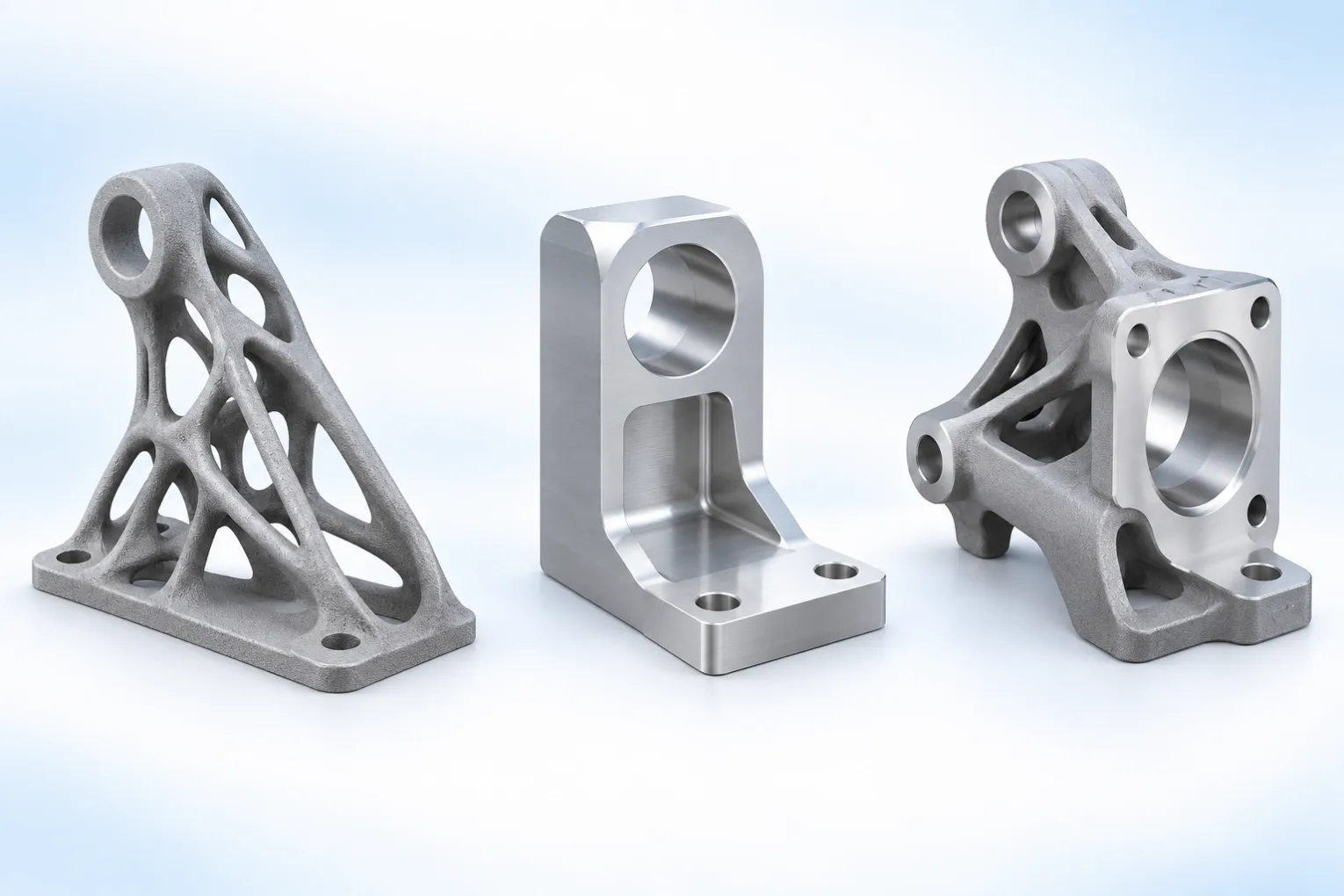
Compare the price of an accepted, usable metal part—not a printed blank against a finished machined component. Metal 3D printing can justify its extra process steps when geometry, weight or assembly consolidation creates value. CNC machining is worth evaluating first when tools can reach the required features and the drawing calls for a conventional stock material. Neither route wins every project.
Send your STEP model and dimensioned drawing for a process review. Include quantities, material requirements, critical interfaces and the needed delivery date. Ask for the proposed route, exclusions and final inspection scope before ordering. YSBK’s current 3D printing service page presents SLA/SLS as its main offering; SLM metal enquiries are reviewed separately. Metal process availability and any secondary operations must be confirmed for your project.
Which Route Deserves a Quote First?
This comparison concerns metal additive manufacturing, especially laser powder bed fusion (often described as SLM or DMLS), and CNC machining. Polymer SLA, SLS and FDM prices or tolerance figures do not establish what a metal process can deliver.
Your requirement | Route to evaluate | What needs confirmation |
|---|---|---|
Accessible pockets, holes, threads and flat interfaces | CNC machining | Tool access, workholding, stock grade, distortion and inspection |
Internal passages or open lattice structures | Metal printing or a redesigned assembly | Build orientation, supports, powder removal, cleaning and inspection access |
Complex body with precision mating faces | Printing plus machining | Machining allowance, datum transfer, clamping and responsibility for final checks |
Repeat batches of a simple solid part | CNC and quantity-based comparison | Setup allocation, cycle time, material supply and repeat-order conditions |
Fewer joints or lower assembly weight | Compare complete assembly alternatives | Functional validation, cleaning, testing and the cost of all finishing steps |
A hidden channel is a reason for an additive design review, not automatic proof of printability. Trapped powder, inaccessible supports and an uninspectable passage can make a design unsuitable. Also ask whether drilled passages with plugs, a split assembly or a design change would meet the same function more economically.
Compare the Complete Cost and Delivery Chain
Ask both routes to quote the same drawing revision, quantity, accepted material condition, finished interfaces, reports and delivery basis. A lower headline unit price can exclude operations your assembly still needs.
For CNC, identify stock, programming, fixtures, cutting, deburring, finishing and agreed inspection. For metal printing, identify build preparation, powder, build time, support and part removal, cleaning, any heat treatment, secondary machining, finishing and agreed inspection. Not every printed part needs every operation, but omissions should be explicit.
EOS describes metal AM as a process chain, including depowdering and post-processing. Protolabs’ metal post-processing guide also discusses machining to improve selected tolerances and surfaces. These explain why a build-only quote is incomplete; they are not YSBK equipment, tolerance or delivery promises.
Do not assume either route is faster. Compare file approval, stock or powder availability, production slot, external treatments, machining, inspection and dispatch readiness. Transit and customs are separate from manufacturing time. Request a dated sequence and clarify which unresolved approval could move it.
A Numerical Quote Example—Not a Supplier Price List
Hypothetical arithmetic only: these are invented comparison inputs, not YSBK prices, market averages or a promised crossover quantity. Suppose two technically acceptable offers for one unchanged design have these simplified totals:
Input | CNC offer A | Metal printing offer B |
|---|---|---|
One-time preparation included in the comparison | USD 300 | USD 100 |
Finished-part variable cost | USD 35 each | USD 65 each |
Total for 5 accepted parts | USD 475 | USD 425 |
Total for 20 accepted parts | USD 1,000 | USD 1,400 |
At 5 pieces, B is lower in this example; at 20, A is lower. The simplified equality is 300 + 35N = 100 + 65N, or about 6.7 pieces. Real quotations may have batch minimums, build packing effects, tiered prices and changing finishing costs, so this calculation is not a seven-piece selection rule. Geometry or material incompatibility can eliminate a route before price is compared.
Request prices at your actual first-order and reorder quantities. Metal printing costs can change with nesting, build height, orientation and batch utilization; they are not universally flat. CNC unit costs can fall as setup is shared, but do not necessarily keep falling indefinitely.
Example RFQ: A Bracket With a Precision Bore
Illustrative specification, not a completed YSBK customer case or a capability guarantee: a buyer needs 5 development brackets, followed by a possible 50-piece batch. The envelope is 80 × 50 × 25 mm. The drawing specifies 6061-T6, a Ø12.000–12.018 mm bore, an M6 × 1 thread and Ra 1.6 μm on one marked mating face.
For a tool-accessible design, ask for a CNC review against those requirements. The bore limits describe an 18 μm size band; they do not define bore position, cylindricity or assembly clearance by themselves. Those requirements need their own definition where function demands them.
If a printing proposal substitutes a different alloy or material condition, it is a design change requiring buyer approval—not the same quote at a different price. Ask what printed grade and condition are proposed and what evidence your application needs. Similar alloy names do not prove equivalent fatigue, corrosion or mechanical performance.
If the bracket changes to include a lattice or internal passage, reopen the comparison. Identify which interfaces require machining after printing and how the part will be held and measured. Do not specify Ra 1.6 everywhere merely because one mating face needs it. Review the surface roughness RFQ guide for defining the measurement scope.
What Different Buyers Should Ask For
First-time buyers: start with function, mating parts, operating conditions and quantity. If you cannot define a tolerance, explain the fit problem and ask what information is missing. A useful supplier response separates assumptions from confirmed requirements and explains the next approval step. A visually acceptable prototype is not automatically validated for service.
Experienced procurement teams: request a route-specific quotation with material condition, critical features, treatment sequence, measurement scope, exclusions and dated milestones. For reorders, identify the released revision and what changes require reapproval. A saved machining program alone does not guarantee repeatability or a reserved production slot.
Traders, wholesalers and resellers: obtain the end customer’s material and acceptance requirements before proposing an alternative process. Compare landed cost and packaging as well as manufacturing price. Agree who approves substitutions and who receives the inspection records. Do not sell a process change as equivalent before the customer accepts it.
E-commerce or retail project owners: distinguish appearance samples from production parts that will carry load, seal or operate in equipment. State expected use and any applicable product requirements. A polished surface or a matching CAD shape does not establish suitability for that use.
The Supplier Response That Helps You Decide
Look for an explanation tied to your part: which feature drives the proposed route, what redesign could remove cost, which surfaces need secondary work and what remains uncertain. Ask for separately priced alternatives where feasible. A supplier adds value by exposing an avoidable operation or an approval risk before the order—not by promising that one process is always cheaper.
For a combined route, have one agreed description of the final delivered part, the handoff datums and the final acceptance checks. Establish who coordinates the steps and handles a discrepancy. Do not assume a printing quote includes subsequent machining or that two providers will automatically accept each other’s work.
Copy This Into Your RFQ
Please review attached STEP and drawing revision [revision] for [first quantity] and [repeat quantity]. Required material and condition: [requirement]. Critical features: [marked dimensions, fits and surfaces]. Application and operating conditions: [details]. Needed delivery date and destination: [details]. Please recommend CNC, metal printing or a combined route with the reason. Identify any material substitution, redesign, secondary operations, inspection scope, exclusions and approval steps. Quote the same final acceptance requirements and state manufacturing milestones separately from shipping.
For tool-accessible trial parts, explore prototype CNC machining. For a repeat batch, see low-volume CNC machining. Request a quotation with the process assumptions identified; metal printing feasibility and availability require project-specific confirmation.
Questions Before Choosing
Is metal 3D printing cheaper than CNC machining?
Sometimes, but there is no universal quantity threshold. Compare technically acceptable routes at the same finished condition, quantity and inspection scope.
Can metal printing replace CNC for a precision bore?
The proposed printing process must be assessed against the actual feature. Secondary boring, reaming or other machining may be needed; confirm allowance, access and measurement before ordering.
Does a printed alloy match a machined stock alloy?
Do not assume equivalence. Agree the grade, condition and application-specific evidence. Substitution needs approval.
Can an internal channel always be printed?
No. Review buildability, powder removal, support access, cleaning and verification. Some designs need a change or a different construction.
Does YSBK automatically include metal printing and post-machining?
No automatic inclusion should be assumed. Submit the files for review and have process availability, material, operations, inspection and delivery confirmed in the quotation.