Sep 7, 2026CNC Machining Guides
What to Include in an RFQ for Custom CNC Machined Brackets
Preparing a CNC machined bracket RFQ? Check the drawing, CAD revision, quantity, material, mounting features, tolerances, finish and inspection requirements to include.
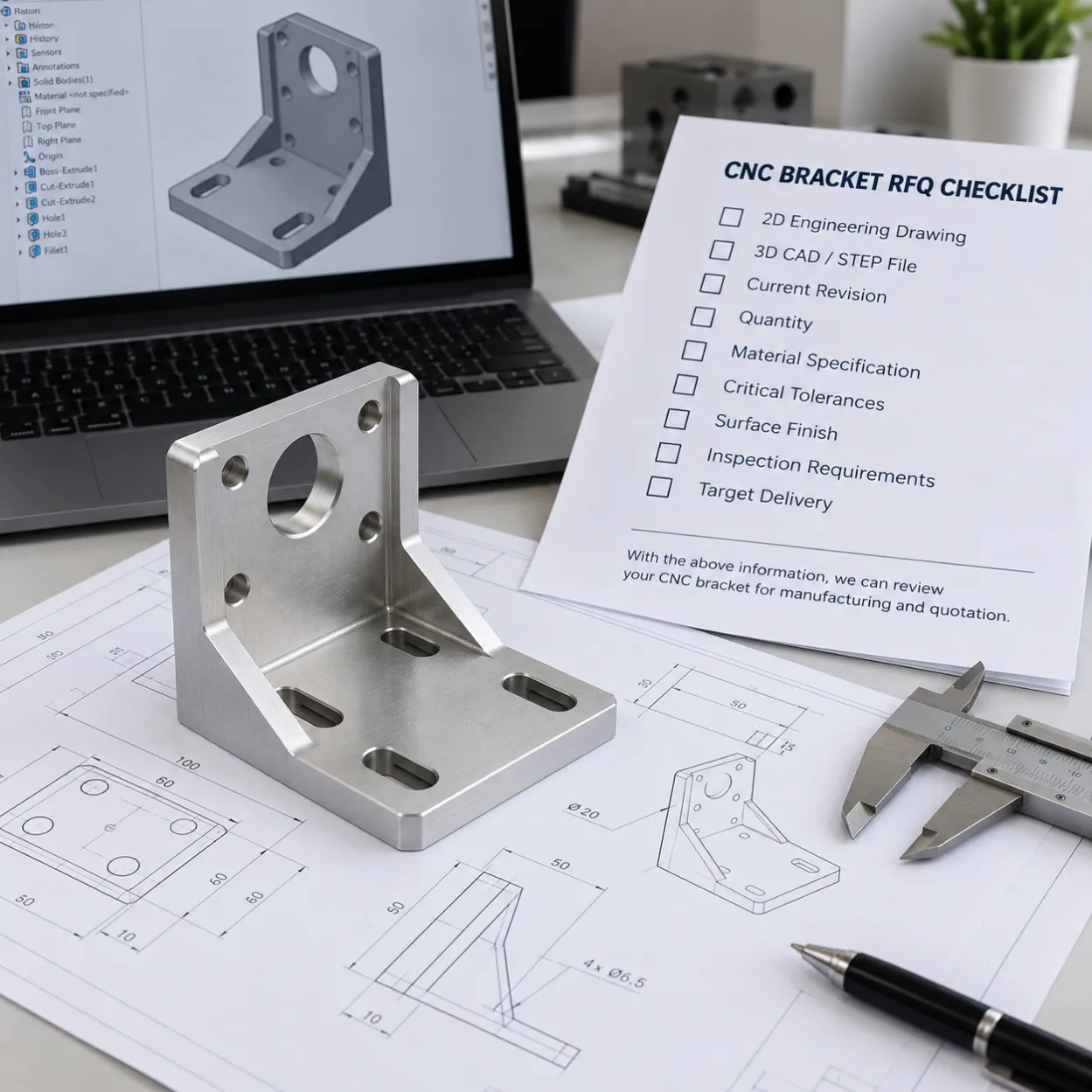
If your CNC bracket is already designed, a useful RFQ should include the current 2D drawing, 3D CAD / STEP file, quantity, material and revision, together with the manufacturing requirements already defined for the part.
For machined brackets, pay particular attention to mounting faces, hole positions, threaded features and datum relationships that affect fit or alignment.
The goal is not to add more information to the drawing. It is to make sure the supplier receives the current engineering documentation and the requirements needed to review the part for manufacturing and quotation.
What Files Should You Send?
Where available, send both:
- 2D engineering drawing
- 3D CAD / STEP file
The 3D model communicates the bracket geometry. The 2D drawing should identify requirements that may not be fully defined by the model, such as:
- Material and grade
- Critical dimensions and tolerances
- Threads
- Surface finish
- Heat treatment, if applicable
- Inspection requirements
Also identify the current drawing or CAD revision.
If several brackets or other machined components belong to the same assembly, include the quantity and current revision for each part number.
Which Bracket Features Should Be Clear on the Drawing?
For a machined bracket, quotation and manufacturing review may depend on the relationship between features rather than the overall shape alone.
Depending on the design, important features may include:
- Mounting and mating faces
- Hole and bore positions
- Threaded holes
- Counterbores and countersinks
- Locating features
- Datum relationships
- Critical dimensional or positional tolerances
For example, if a bracket positions a sensor, actuator or another component relative to an assembly, the relationship between its mounting face and locating holes may be more important than a non-functional external dimension.
These requirements should come from the customer-controlled engineering documentation.
The supplier should not be expected to determine which features are functionally critical or to redesign the bracket during quotation.
What Quantity and Material Information Is Needed?
State the required quantity for each part number.
If the engineering team has already specified a material, provide the actual grade rather than only a general description such as “aluminum” or “steel.”
For example:
Aluminum 6061-T6
is more useful for quotation than:
Aluminum
The purpose is not to ask the machining supplier to select the material for the application. The RFQ should communicate the material already defined by the project requirements.
Should Finishing and Inspection Be Included in the RFQ?
Yes, when they are part of the released requirement.
For example, identify whether the bracket requires:
- Anodizing
- Plating
- Black oxide
- Heat treatment
- Grinding or another specified secondary process
If critical dimensions or surfaces must be inspected after finishing, identify those requirements on the drawing or RFQ documentation.
Also state whether specific inspection records or other documentation are required with the order.
This allows the supplier to consider machining, finishing and inspection requirements together when preparing the quotation.
Does the Supplier Need to Know the Project Stage?
A short description of the current manufacturing stage can help clarify the requirement.
For example:
- One-off prototype
- Revised engineering part
- Small production batch
- Repeat order against an existing revision
For released designs moving into small or repeat production batches, see Low-Volume CNC Machining for Engineering Parts.
There is no need to provide confidential information about the complete machine or product unless it is relevant to manufacturing the component.
CNC Machined Bracket RFQ Checklist
Before sending the RFQ, check whether you have provided:
RFQ Item | What to Confirm |
|---|---|
Drawing | Current 2D engineering drawing |
CAD | STEP / STP or available 3D model |
Revision | Current revision for each part number |
Quantity | Required quantity per part |
Material | Defined material and grade |
Critical Features | Mounting, locating, hole, thread or datum requirements |
Tolerances | Drawing-defined critical tolerances |
Finishing | Anodizing, plating, heat treatment or other requirements |
Inspection | Critical inspection or documentation requirements |
Delivery | Required or target delivery |
If these items are already defined, the project is normally ready for an initial manufacturing review.
Have a CNC Bracket Ready for Quotation?
If your bracket is already defined by a 2D drawing and 3D CAD / STEP file, see our Custom CNC Machined Brackets manufacturing page.
Submit the current drawing information, quantity, material and critical requirements for review.