Sep 21, 2026CNC Machining Guides
POM vs Nylon vs PTFE vs PEEK for CNC Machined Parts
Compare POM, nylon, PTFE and PEEK for CNC machined parts. Review dimensional stability, moisture, heat and RFQ requirements before choosing a grade.
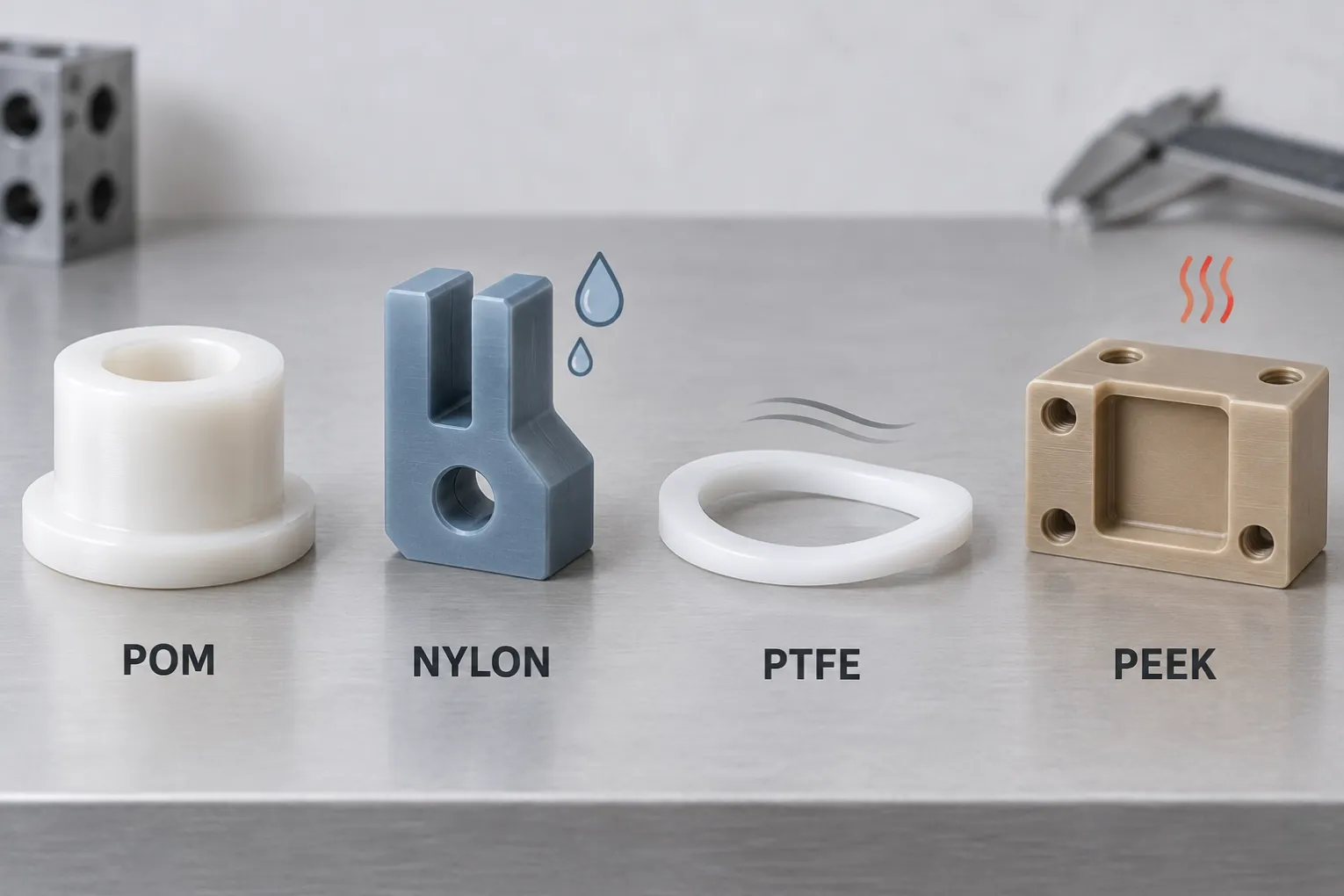
Material selection depends on dimensional stability, moisture, temperature, friction, load and part geometry.Choosing an engineering plastic for a CNC machined component involves more than selecting a material that can be cut to shape.
The finished part may need to maintain a precise fit, carry a mechanical load, slide against mating hardware, resist chemicals, or remain dimensionally stable as temperature and humidity change. These conditions affect both material selection and realistic tolerance planning.
YSBK normally machines to the material and grade specified on the customer drawing. During prototype development, we can also share machining-oriented observations while engineers compare POM, nylon, PTFE and PEEK.
Final material selection and validation for the intended operating environment remain the customer’s responsibility.
Start With the Part Function
POM, nylon, PTFE and PEEK are not interchangeable materials. Before comparing them, define what the component must do:
- Will it function as a bushing, spacer, guide, seal, insulator, housing or structural component?
- Which dimensions control assembly fit and alignment?
- Will it contact water, oil, solvents or cleaning agents?
- What continuous and peak temperatures will it experience?
- Is low friction more important than stiffness?
- Will the part carry a sustained mechanical load?
- Is the geometry thin-walled, flexible or heavily pocketed?
- Is the requirement for a one-off prototype, a small batch or recurring production?
A material that performs well in one application may introduce unnecessary cost or dimensional risk in another.
Quick Comparison for CNC Machined Parts
The following comparison focuses on practical machining and dimensional considerations rather than treating datasheet values as guaranteed finished-part performance.
Actual results depend on the exact grade, filler content, raw stock condition, part geometry and operating environment.
Material | Common reasons for considering it | Important machining or dimensional concern |
|---|---|---|
POM / Acetal | Dimensional stability, low moisture uptake and wear-resistant sliding applications | Thin or heavily machined geometries can move as residual stress in the stock is released |
Nylon / PA | Toughness, wear resistance and mechanical damping | Moisture absorption can cause dimensional and property changes over time |
PTFE | Very low friction and broad chemical resistance | Softness, springback and creep make tight dimensions difficult to maintain |
PEEK | High-temperature performance, chemical resistance and strong mechanical properties | Results depend heavily on grade, stock condition, machining heat and the amount of material removed |
POM / Acetal: Often a Starting Point for Stable Mechanical Components
POM, also known as acetal, is frequently considered for bushings, spacers, guides and other mechanical components requiring low-friction sliding and relatively stable dimensions.
Its low moisture uptake makes it less sensitive to humidity than nylon. However, this does not mean every POM part will remain flat after machining.
YSBK has machined large, thin POM plate-style components where the material moved after cutting. In this type of geometry, removing a substantial amount of material can disturb the stress balance inside the original stock. Bowing may become visible after the part cools and is released from the fixture.
For geometries with elevated deformation risk, machining considerations may include:
- Reducing cutting loads
- Removing material in shallow, staged passes
- Limiting concentrated cutting heat
- Selecting lower-stress stock where available
- Discussing the inherent flatness risk before production
POM can be a practical choice for many sliding and mechanical applications, but large thin surfaces and highly asymmetrical material removal still require careful review.
Nylon / PA: Useful for Wear and Toughness, but Moisture Matters
Nylon is often considered where toughness, wear resistance and mechanical damping are important.
However, specifying only “nylon” is usually insufficient. PA6, PA66, PA12, cast nylon and filled grades can behave differently during machining and in service.
Moisture absorption is an especially important consideration because it can change both dimensions and material properties.
YSBK has encountered nylon components containing long cantilevers and thin slotted features. After machining, the slotted areas showed springback, changing the opening dimension. Subsequent moisture exposure could introduce further dimensional movement.
Smaller cutting steps and reduced local heat can help control machining-related movement, but machining cannot remove nylon’s underlying moisture sensitivity.
Where moisture exposure may affect the part, define the following before quotation:
- Exact nylon grade and filler specification
- Expected operating humidity
- Whether critical dimensions apply in a dry or conditioned state
- Mating-part and assembly requirements
- Whether moisture conditioning is required
YSBK does not perform nylon conditioning in-house. If conditioning is specified on the drawing, we can help arrange third-party processing at the customer’s request.
PTFE: Strong Friction and Chemical Performance With Dimensional Limits
PTFE is often selected for seals, gaskets, sliding rings and other components requiring very low friction or chemical resistance.
Its machining behavior differs significantly from that of more rigid engineering plastics. PTFE is soft, responds to cutting and clamping pressure, and can creep under sustained mechanical load.
YSBK has machined thin PTFE rings and gaskets where cutting pressure caused material displacement and springback. This affected thickness and internal diameter. Slow dimensional movement after machining also had to be considered.
Practical machining measures for PTFE parts may include:
- Using sharp cutting tools to reduce material displacement
- Keeping cutting pressure low
- Supporting the part carefully during machining
- Avoiding clamping forces that distort thin features
- Reviewing whether requested tolerances are realistic for the material
A dimension measured immediately after machining does not guarantee that the part will maintain the same value under temperature, pressure or long-term load.
Where sealing or assembly fit is critical, the operating conditions should be shared before manufacturing review. PTFE should not be selected only for its friction or chemical characteristics; its dimensional behavior must also suit the assembly.
PEEK: Higher Performance Does Not Eliminate Machining Risk
PEEK is often specified when a component requires a combination of heat resistance, chemical resistance and mechanical performance.
However, unfilled, glass-filled and carbon-filled PEEK grades are not interchangeable from a machining perspective. The selected grade, raw stock condition, part geometry and cutting strategy all affect the finished result.
YSBK has encountered PEEK parts machined from thick blanks with deep pockets or large thin-wall areas. Removing a large volume of material from one side can release residual stress in the stock. Concentrated cutting heat can introduce additional dimensional movement.
For PEEK geometries with elevated deformation risk, machining considerations may include:
- Removing material in staged layers
- Controlling heat during machining
- Leaving a small finishing allowance on critical features
- Performing a secondary finishing pass
- Using supplier-annealed PEEK stock where specified and available
YSBK does not perform PEEK annealing or stress-relief treatment in-house. When a drawing requires these processes, we can help arrange third-party treatment. The required treatment and process sequence should be confirmed before production.
For a more detailed discussion of PEEK-specific dimensional risks, see PEEK Machining Tolerances: How to Prevent Warping and Dimensional Changes.
Material Selection Should Not Begin With a Universal Tolerance
An instruction such as “machine this plastic part to a tight tolerance” does not provide enough information for a meaningful manufacturing review.
Realistic tolerance planning depends on:
- Exact material and grade
- Incoming stock condition
- Overall part size
- Wall thickness
- Pattern and volume of material removal
- Location of functionally critical features
- Temperature and humidity exposure
- Fixturing and inspection conditions
- Mating-part and assembly requirements
Applying tight tolerances to every dimension can increase machining and inspection effort without improving part function.
A better approach is to identify the dimensions that control fit, sealing, alignment or motion. These features can then receive the appropriate manufacturing and inspection attention.
What YSBK Can and Cannot Decide
YSBK can review how the specified plastic is likely to respond during CNC machining and identify manufacturing risks associated with geometry, tolerance requirements, thin walls, fixturing or material-removal strategy.
During prototype development, we can also provide machining-oriented observations while the customer evaluates POM, nylon, PTFE and PEEK.
However:
- YSBK does not replace the customer’s material or application engineer.
- We cannot guarantee that a material is suitable for its final operating environment.
- We cannot assign one universal tolerance to every plastic part.
- We do not perform annealing, stress relief or nylon conditioning in-house.
- Final material grade selection and application validation remain the customer’s responsibility.
If the drawing requires annealing, stress relief or conditioning, YSBK can help arrange qualified third-party processing and include it in the manufacturing review and quotation scope.
What to Send Before Requesting a Quote
For a useful manufacturing review and quotation, please provide:
- A STEP, STP or equivalent 3D CAD file
- A dimensioned 2D engineering drawing
- The confirmed material grade or the alternatives being evaluated
- Required quantity
- Critical dimensions and mating-fit requirements
- Relevant assembly context
- Expected operating-temperature range
- Exposure to humidity, chemicals or friction
- Inspection or material-documentation requirements
- Any specified annealing, stress-relief or conditioning treatment
- Current drawing revision
If the material has not been finalized, describe the part function and expected service conditions. YSBK can provide machining-relevant observations, while material approval remains with the customer’s engineering team.
Send Your Drawing for Manufacturing Review and Quotation
Whether the plastic grade has already been specified or is still being evaluated for prototype development, YSBK can review the part from a CNC manufacturing perspective.
When you are ready, send your drawing and project requirements for manufacturing review and quotation.